Kicker Rock 2026: Swim with Hammerhead Sharks from San Cristóbal
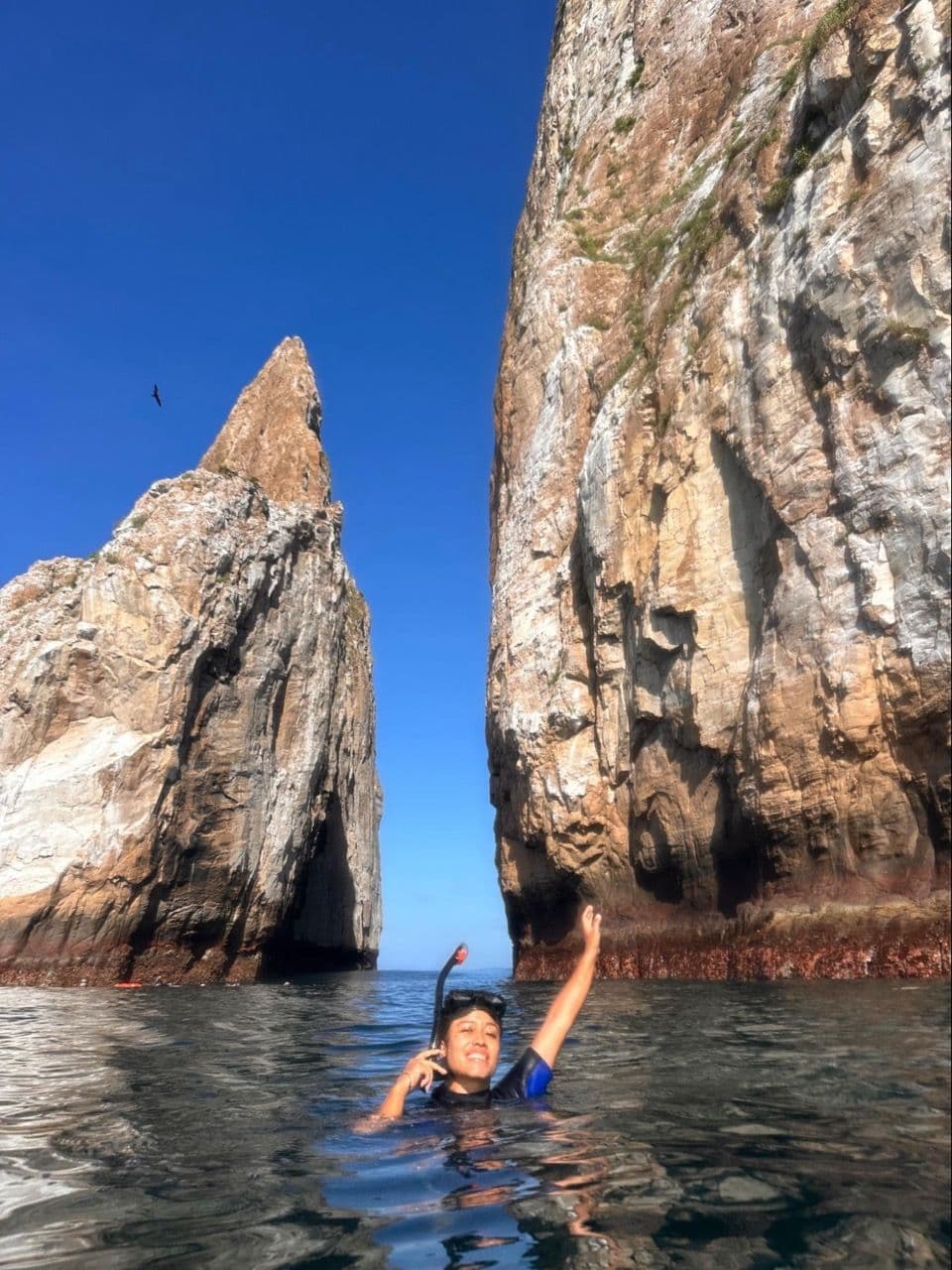
There is a moment, an hour by boat from Puerto Baquerizo Moreno, when the engine slows and everyone on board stops talking. Ahead of you, two vertical walls of dark rock rise from the water, splitting the horizon in two. From the southeast, they resemble a reclining lion, which is why locals call the formation León Dormido. English sailors named it Kicker Rock because its outline looks like a boot about to kick. But the name that matters lies beneath the water: this is the only place in Galápagos where you can swim at the surface, with no tank or certification, while a school of hammerhead sharks crosses the channel beneath your feet.
Kicker Rock consists of two vertical volcanic tuff rocks about 486 feet (148 m) tall, located an hour from Puerto Baquerizo Moreno on San Cristóbal. Between them is a channel where you can snorkel at the surface not only with hammerhead sharks (Sphyrna lewini), but also with Galápagos sharks, green sea turtles, and eagle rays. This full-day tour lets you explore Galápagos' extraordinary biodiversity without knowing how to scuba dive.
This guide explains what you can see in each season, how much a tour costs, how to book without falling for unlicensed operators, and why this site deserves a place on your San Cristóbal itinerary.
Planning your island trip? Start with our guide to the top things to do on San Cristóbal Island, and add Kicker Rock to your itinerary.
Cover photo:Snorkeling at Kicker Rock, by @diana_viajando on Instagram.
What Is Kicker Rock?
Kicker Rock is not one rock, but two. They are the two vertical remnants of an ancient volcanic tuff cone that the sea eroded over thousands of years, and the famous "channel" separating them is what remains of the collapsed crater. That distinction, two walls with a passage of water between them, is precisely what makes the site so special for snorkeling and so difficult to match elsewhere in the archipelago.
Why Is It Called "León Dormido"?
The name comes from its silhouette. Viewed from the southeast, the two rocks form the profile of a lion reclining on the water, its head resting and its back stretched out. In Spanish, the name became León Dormido. English-speaking sailors saw something else, an outline resembling a boot delivering a kick, and called it Kicker Rock. Today, both names appear on maps and in tour names, so do not be confused: León Dormido and Kicker Rock are exactly the same place.
How Did Kicker Rock Form?
Kicker Rock rises approximately 486 feet (148 m) above sea level (Galápagos National Park, Learn About Our Visitor Sites, 2023), although different sources cite figures of 486, 492, and even 499 feet (148, 150, and 152 m). Geologically, it is an eroded tuff cone: the two peaks you see are the sides of a crater that waves split in half. It belongs to the same family of formations found at Pinzón and Daphne, and is very different from the recent lava at sites such as Las Tintoreras on Isabela. What you cannot see from the boat is most impressive: the vertical walls continue underwater and plunge more than 328 feet (100 m) within a short distance of the visible rock face.
A National Park Marine Visitor Site with No Landings
Kicker Rock is a Galápagos National Park marine visitor site: visitors may not go ashore or walk on the rocks, and may only navigate around them and snorkel or scuba dive within the authorized zone. This means the entire experience takes place in the water and from the boat, always with a certified naturalist guide on board. The rule is not arbitrary. It protects a concentrated, fragile marine ecosystem and is why there is no legal way to visit independently.
What Will You See at Kicker Rock?
Kicker Rock's main attraction is swimming with sharks at the surface. The channel between the two rocks serves as a corridor for hammerhead, Galápagos, and whitetip reef sharks, while the vertical walls attract green sea turtles, eagle rays, and reef fish. No wildlife sighting is guaranteed, but the odds are high and vary by season.
Hammerhead Sharks (Sphyrna lewini): The Tour's "Grand Prize"
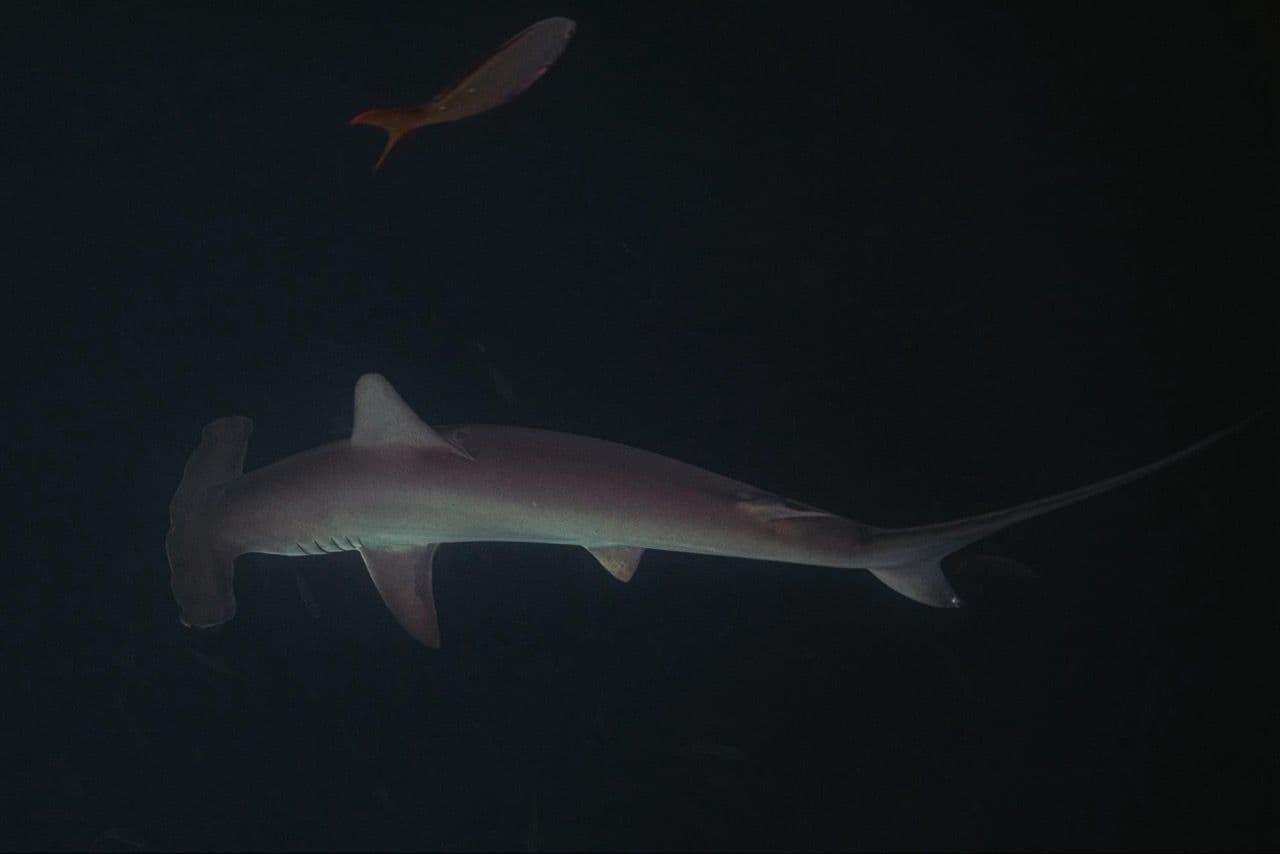
Hammerhead shark
Photo by @elmartindeibarra on Instagram.
The hammerhead shark (Sphyrna lewini) is why most people book this tour. They form groups of 5 to 40 individuals that cross the channel in deep water, especially from June through November, when upwelling from the Cromwell Current cools the water and attracts them. Although they travel at depth, they often rise to 16–49 feet (5–15 m), close enough to see clearly from the surface. The species is listed as Critically Endangered on the IUCN Red List, making every sighting a privilege. Despite their size, they are shy and harmless to snorkelers, with no recorded attacks on humans at the surface.
Swimming among hammerhead sharks is awe-inspiring. Knowing they are gliding around you creates a feeling that combines wonder with deep respect for nature. It is a dazzling experience that reveals the extraordinary scale of Galápagos' biodiversity.
Galápagos Shark (Carcharhinus galapagensis)
The Galápagos shark (Carcharhinus galapagensis) patrols the vertical walls on the rock's eastern side. This species is associated with the archipelago and other oceanic islands in the eastern Pacific, and adults can reach 10 feet (3 m) long. The IUCN lists it as Near Threatened (IUCN Red List). You will see it moving slowly and gracefully along the underwater wall, almost always alone or in pairs, unlike hammerheads, which travel in groups.
Whitetip Reef Sharks (Triaenodon obesus)
The whitetip reef shark (Triaenodon obesus) is the easiest to find because it does not need to swim to breathe. Unlike many sharks, it actively pumps water over its gills, so it spends the day resting in caves and on rocky shelves. It hunts at night and rests by day. Do not confuse it with the blacktip reef shark (Carcharhinus melanopterus), which does not inhabit Galápagos. Look for whitetips lying still on the walls' lower ledges as you swim around them.
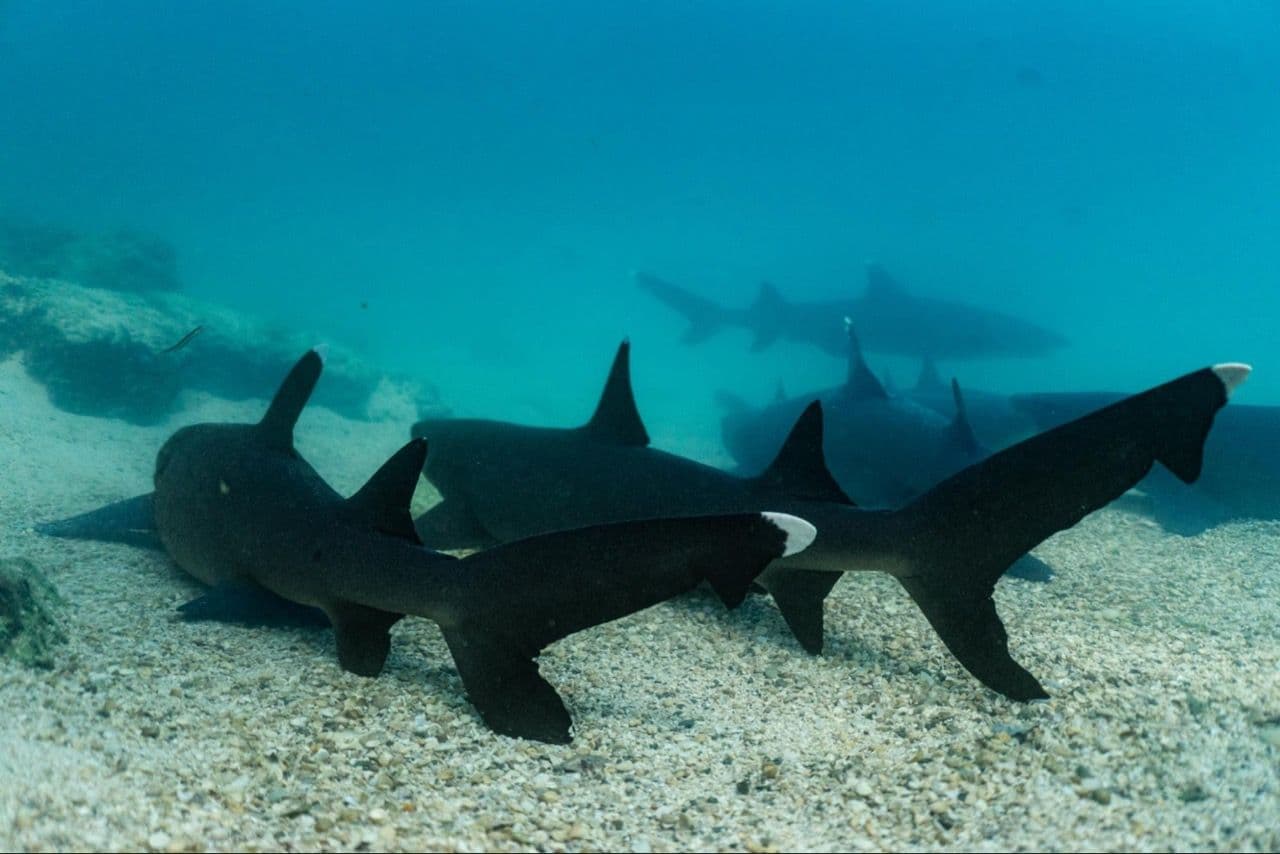
Whitetip reef shark
Photo by @elmartindeibarra on Instagram.
Green Sea Turtles (Chelonia mydas agassizii) and Eagle Rays (Aetobatus narinari)
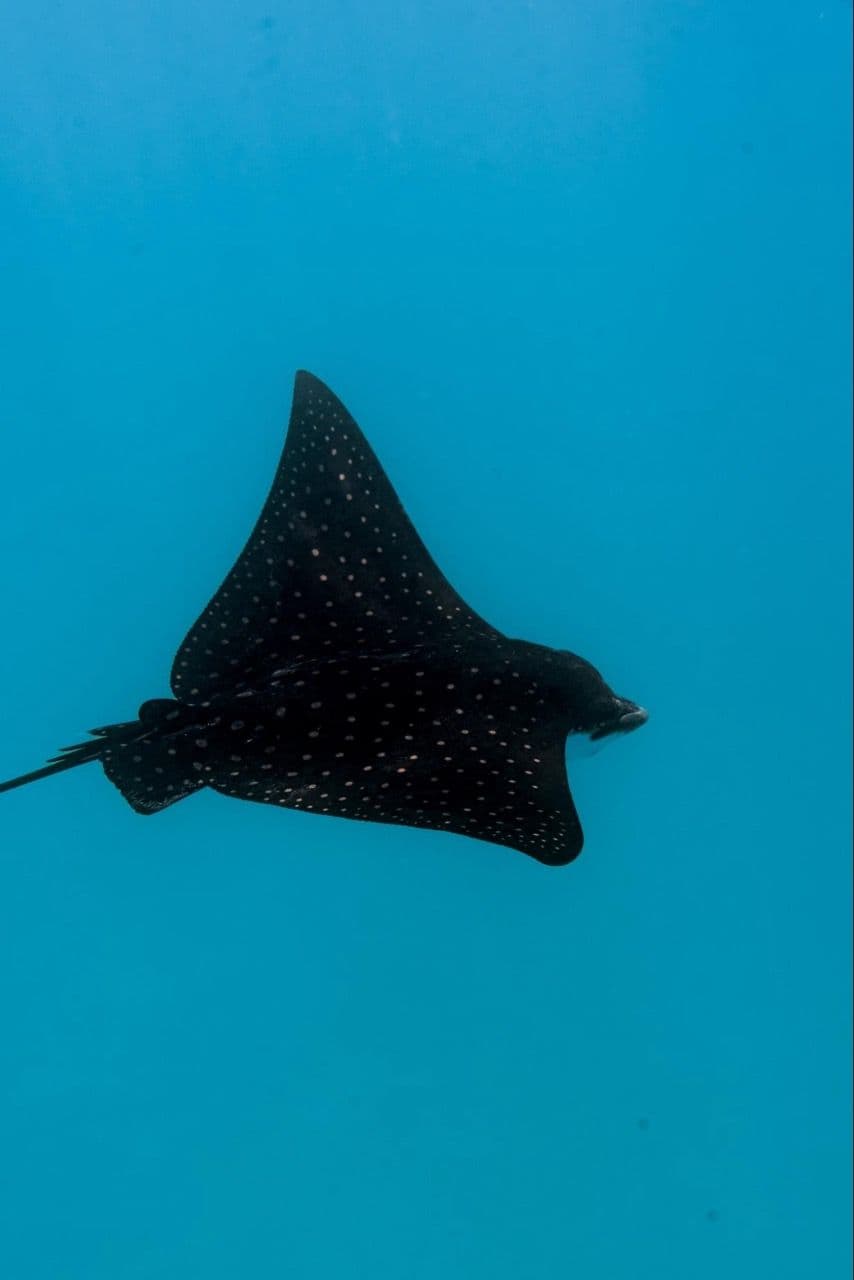
Eagle rays
Photo by @elmartindeibarra on Instagram.
Green sea turtles (Chelonia mydas agassizii) are an almost constant presence inside and outside the channel. Locally, they are also known as "black turtles" because of their darker coloring. This is the eastern Pacific subspecies. Spotted eagle rays (Aetobatus narinari), with wingspans of up to 10 feet (3 m), sometimes appear in schools that cross the channel like squadrons. During the warm season, there are also occasional sightings of giant oceanic manta rays (Mobula birostris). Along with reef fish, these are the animals you will almost always see, even if the hammerheads decide not to appear that day.
Birds: Blue-Footed Boobies (Sula nebouxii), Frigatebirds (Fregata magnificens), and Nazca Boobies (Sula granti)
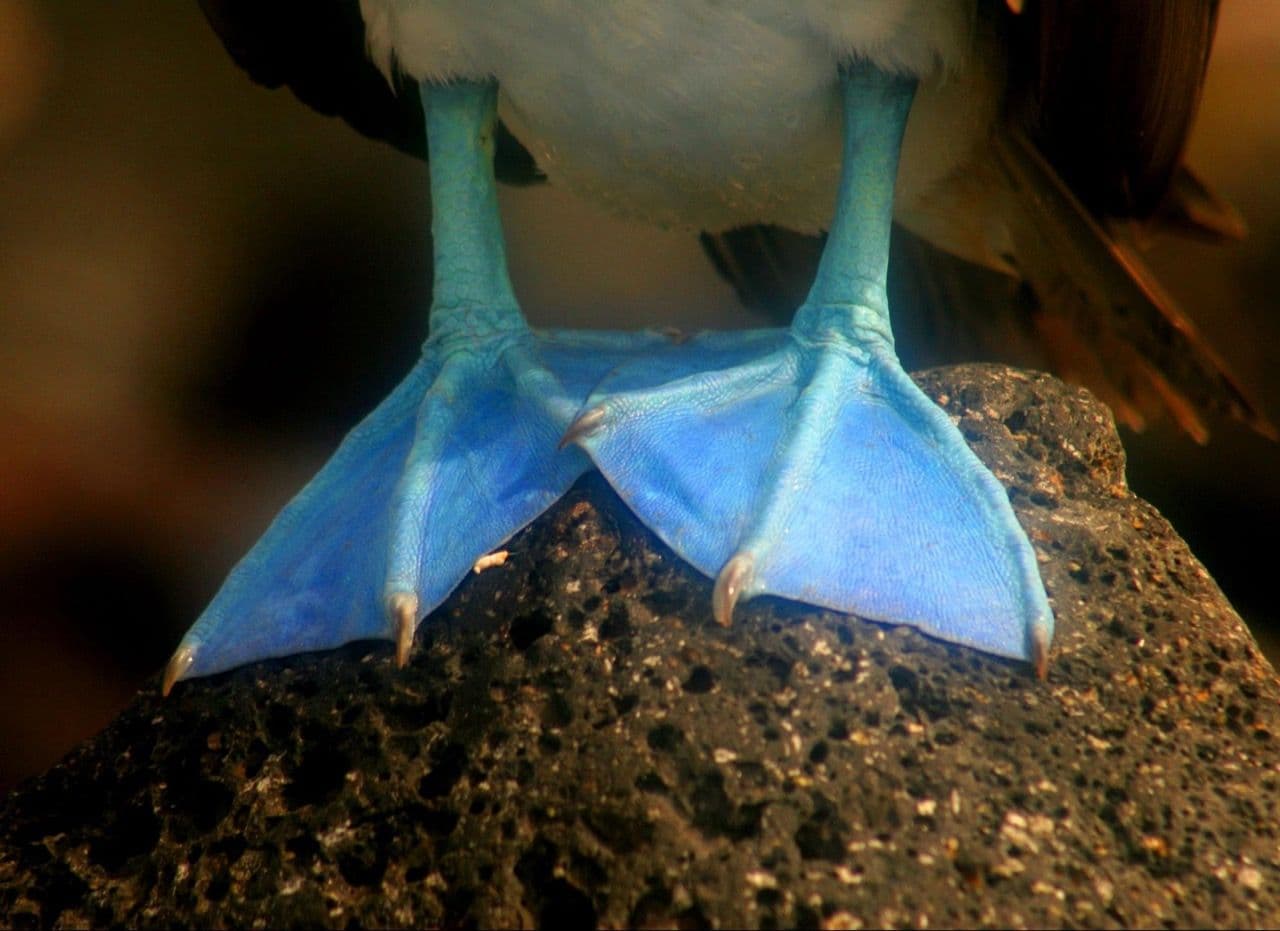
Blue-footed boobies.
Photo by Ecuador's Ministry of Tourism.
Not all the wildlife is underwater. As you navigate around the rock, birds crowd its ledges: blue-footed boobies (Sula nebouxii), recognizable by their vivid blue feet; Nazca boobies (Sula granti), distinguished by their black facial masks and usually found on higher ledges; and magnificent frigatebirds (Fregata magnificens), which soar around the entire rock and display inflated red throat pouches during breeding season. The frigatebird is the archipelago's "aerial pirate," stealing food from other birds in midair, a spectacle worth having your camera ready for.
When Should You Visit Kicker Rock?
The best time to visit Kicker Rock depends on what you want to see. If hammerhead sharks are your priority, travel during the cool season from June through November. If you want better visibility, turtles, and rays, the warm season from December through May is your best option. There is no bad season because wildlife is always present, but your timing will determine what you are most likely to see.
Cool Season (Jun–Nov)
From June through November, the Cromwell Current (Equatorial Undercurrent) causes cold, nutrient-rich water to well up in the western and northwestern parts of the archipelago. Water temperatures fall to 66–72°F (19–22°C), and visibility drops to 26–39 feet (8–12 m), but hammerhead sharks arrive in the channel. Your estimated chance of seeing them rises to 60–70%. This is the season for shark lovers, with one condition: a 0.2-inch (5 mm) wetsuit is required to stay warm during snorkeling sessions.
Warm Season (Dec–May)
From December through May, the warm Panama Current dominates. Water temperatures rise to 75–82°F (24–28°C), and visibility improves significantly to 39–66 feet (12–20 m), making the experience more comfortable and photogenic. This is the best season for green sea turtles, rays, and wildlife near the surface, although the chance of seeing hammerheads falls to 25–35%. A 0.12-inch (3 mm) wetsuit is enough. If you are traveling with children or do not tolerate cold water well, this is your season.
Month-by-Month Species Probability Table
| Month | Water temperature | Visibility | Featured species |
|---|---|---|---|
| January | 75–82°F (24–28°C) | 39–66 ft (12–20 m) | Turtles, rays |
| February | 75–82°F (24–28°C) | 39–66 ft (12–20 m) | Turtles, rays |
| March | 75–82°F (24–28°C) | 39–66 ft (12–20 m) | Turtles, eagle rays |
| April | 75–81°F (24–27°C) | 39–59 ft (12–18 m) | Turtles, rays |
| May | 72–77°F (22–25°C) | 33–49 ft (10–15 m) | Transition (turtles + first hammerheads) |
| June | 68–73°F (20–23°C) | 26–39 ft (8–12 m) | Hammerhead sharks (season begins) |
| July | 66–72°F (19–22°C) | 26–39 ft (8–12 m) | Hammerhead sharks (high) |
| August | 66–72°F (19–22°C) | 26–39 ft (8–12 m) | Hammerhead sharks (high) |
| September | 66–70°F (19–21°C) | 26–39 ft (8–12 m) | Hammerhead sharks (high) |
| October | 66–72°F (19–22°C) | 26–39 ft (8–12 m) | Hammerhead sharks (high) |
| November | 68–73°F (20–23°C) | 30–43 ft (9–13 m) | Hammerhead sharks (season ends) |
| December | 72–77°F (22–25°C) | 33–52 ft (10–16 m) | Transition (turtles) |
Have dates in mind for your trip? Contact us, and we will tell you what wildlife to expect when you visit.
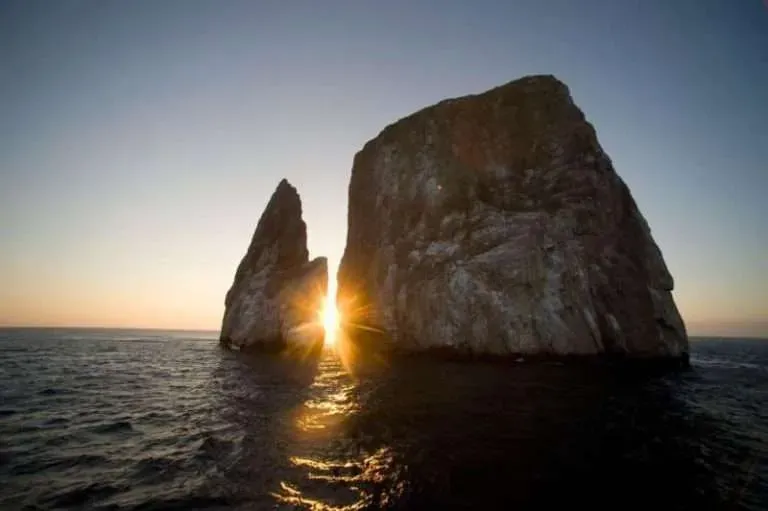
Kicker Rock.
Cover photo by Ecuador's Ministry of Tourism.
What Are Your Options for Visiting Kicker Rock?
You have three options for visiting Kicker Rock from San Cristóbal:
- Full-day snorkeling tour.
- Full-day scuba diving tour.
- A stop on the 360 Tour.
What Is the Full-Day Tour Like?
The Kicker Rock tour is a full-day excursion lasting about 8 to 9 hours. It leaves early from the Puerto Baquerizo Moreno pier and combines navigation, two snorkeling sessions, lunch on board, and a secondary beach stop. There is no standard half-day option because the distance to the site requires a full day.
Departure from the Puerto Baquerizo Moreno Pier
Departure is between 7:00 and 8:00 a.m. from the Puerto Baquerizo Moreno pier on San Cristóbal Island. Before setting sail, the guide gives a safety briefing and distributes the equipment: mask, snorkel, fins, life jacket or flotation device, and wetsuit. The early start is not the operator's whim. Winds pick up toward midday, and the best windows for calm seas and good visibility are in the morning.
Boat Ride to Kicker Rock
The boat ride northeast from the pier to Kicker Rock takes about one hour. This is an open-ocean crossing, so if you are prone to seasickness, take motion-sickness medication about 30 minutes before departure. Use the trip to hydrate and calmly adjust your gear before your first entry into the water.
Two Snorkeling Sessions
The tour includes two snorkeling sessions of about 45 minutes each. When the swell allows, the first usually takes place inside the channel, where hammerhead sharks gather and you can feel the walls plunging vertically beneath your fins. If the swell rises above approximately 5 feet (1.5 m), the captain closes the channel for safety and snorkeling takes place outside the rocks. The water there is shallower, with a greater chance of turtles and a lower chance of hammerheads. This is an informal but sensible rule, and an honest operator will explain it before you enter the water.
Lunch on Board + Secondary Stop (Playa Manglecito or Cerro Brujo)
Between sessions, lunch is served on board, typically rice, a protein, salad, fruit, and water. During this part of the trip, the boat heads to a secondary stop on land. Playa Manglecito is the most common, although some operators include Cerro Brujo depending on the weather and itinerary. This stop gives you time to rest, enjoy the beach, and sometimes take an easy second snorkel from shore.
Return
You will return to the Puerto Baquerizo Moreno pier between 4:00 and 5:00 p.m., your mind filled with underwater images and the satisfaction of completing one of the most remarkable excursions in the Galápagos Islands. A trip to Kicker Rock is, without exaggeration, one of those days that justifies the entire journey to San Cristóbal.
On the way back to the pier, your body carries the pleasant fatigue that follows a great adventure. Your skin is still salty, your hair is tousled by the wind, and your smile is hard to erase. On the boat, everyone excitedly talks about what they saw underwater: who spotted the most hammerheads, the turtle that swam so close, or the moment when the ocean seemed to stand still. Amid laughter, photos, and quiet reflection comes the certainty that you experienced something truly special. For a few hours, you were part of a magical world you will never forget.
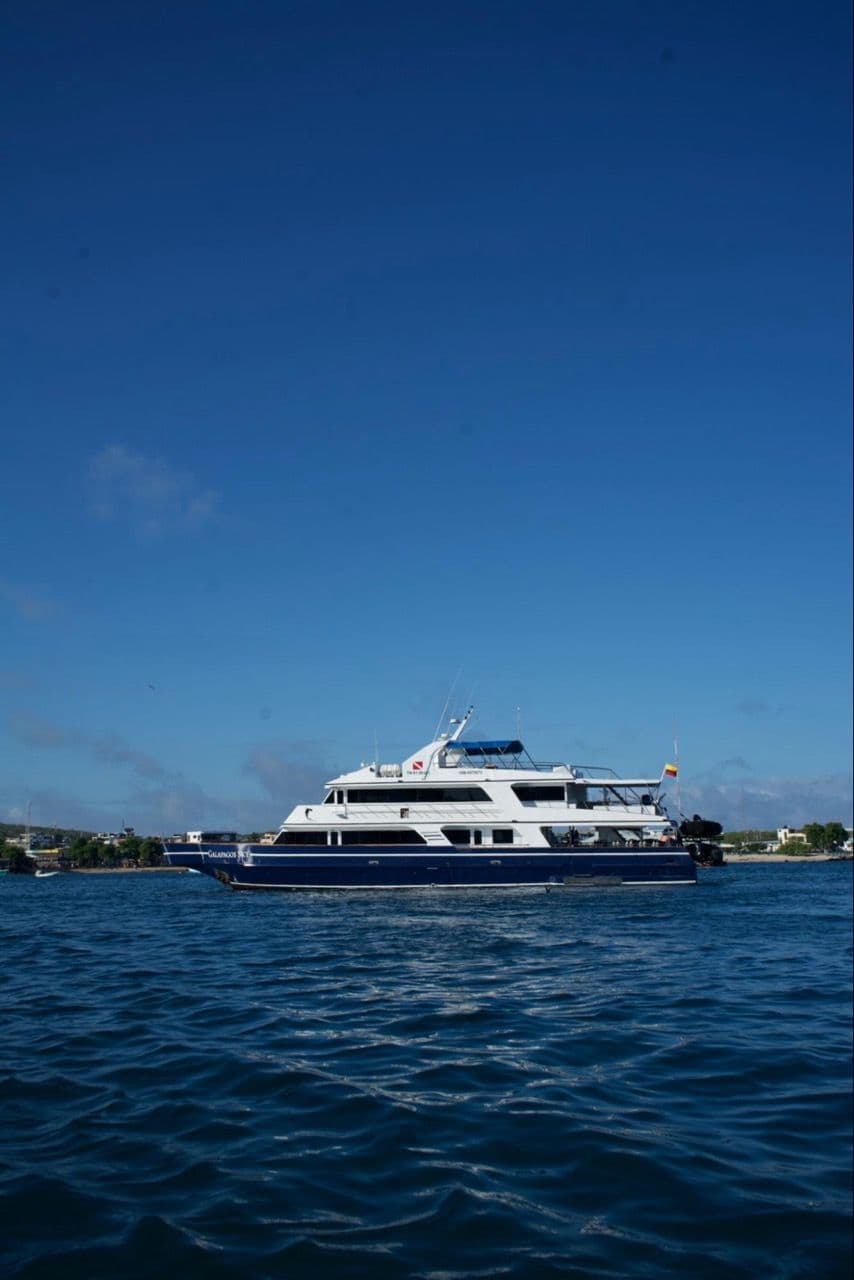
Boat used for the Kicker Rock tour.
Photo by @elmartindeibarra on Instagram.
Snorkeling vs. Scuba Diving: Which Tour Should You Book?
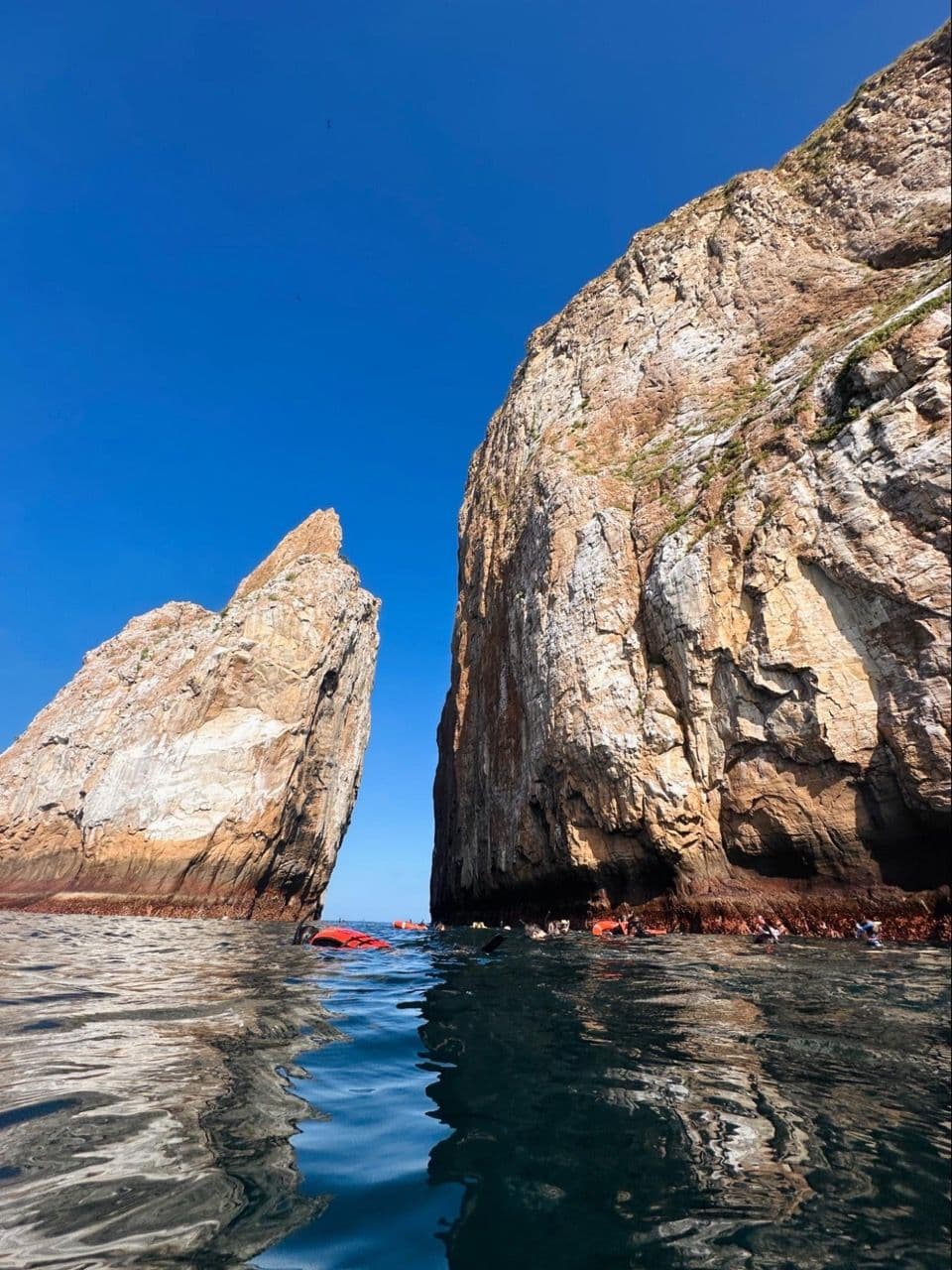
Snorkeling at Kicker Rock.
Photo by @diana_viajando on Instagram.
There are two very different ways to experience Kicker Rock, and confusing them could lead to disappointment. Snorkeling takes place at the surface, requires no certification, and is suitable for anyone who swims confidently. Certified scuba diving involves deep dives and requires prior experience. Before paying, make sure you know exactly which tour you are booking.
Snorkeling Tour (Starting at $180 USD, No Certification, Suitable for Confident Swimmers)
The snorkeling tour starts at $180 USD, requires no certification, and takes place at the surface with a life jacket or flotation device provided by the operator. It is accessible to anyone who can swim and feels comfortable floating in a moderate current. Here is the good news for non-divers: the channel's hammerheads often rise to 16–49 feet (5–15 m), so you can see them clearly from above. You do not need a tank for the full experience.
Scuba Diving Tour (Starting at $250 USD, Two Dives at 59–98 Feet (18–30 m), Open Water Certification + Current Experience Required)
The scuba diving tour starts at $250 USD for two dives at depths of 59–98 feet (18–30 m). It requires at least an Open Water certification plus prior experience in currents. Galápagos is not the place for your first dive after certification: the currents are strong and demand control. If you have the certification and experience, scuba diving brings you closer to Galápagos sharks and the deep walls in a way snorkeling cannot. If you are unsure of your ability, choose snorkeling only.
Snorkeling vs. Scuba Diving Comparison
| Criterion | Snorkeling tour | Scuba diving tour |
|---|---|---|
| Price | Starting at $180 USD | Starting at $250 USD |
| Certification | Not required | Open Water minimum |
| Prior experience | Confident swimming | Diving in currents |
| Depth | Surface (wildlife at 16–49 ft (5–15 m)) | 59–98 ft (18–30 m) |
| Sessions | 2 snorkeling sessions (~45 min) | 2 dives |
| Best for | Confident swimmers | Experienced divers |
Interested in certified scuba diving or snorkeling at Kicker Rock? Contact us, and we will help you find the perfect tour.
Tour 360
Quito Tour Bus offers another way to experience Kicker Rock. As part of our Galápagos tours, specifically our Santa Cruz and San Cristóbal Tour, we offer the 360 Tour. It is an ideal experience for discovering some of the island's most iconic landscapes in a single day. The day begins with breakfast at the hotel before boarding a boat for an approximately six-hour journey along the coast of San Cristóbal.
Along the way, you will visit iconic places such as La Lobería, known for sea lions in their natural habitat; Playa Mann, one of the island's most popular beaches; Punta Carola, famous for its impressive ocean views; and Cerro Tijeretas, a prime spot for watching seabirds and enjoying spectacular panoramas.
During the excursion, travelers can snorkel in the waters around Kicker Rock, where a great variety of marine life may be seen, and take part in birdwatching activities featuring species characteristic of Galápagos. It is a complete experience combining nature, adventure, and some of San Cristóbal's most beautiful places.
Tour Price: What Is Included and Which Operators Are Authorized?
In 2026, the full-day Kicker Rock snorkeling tour starts at $180 USD per person, while the certified scuba diving tour starts at $250 USD. These prices do not include entry fees for the archipelago, and you should book only with an operator authorized by the National Park. Here is the honest breakdown.
2026 Price Range
Starting prices of $180 USD for snorkeling and $250 USD for scuba diving are the 2026 market reference. Rates vary by operator, season, and whether the secondary stop includes a second beach. Buying directly from an agency in Puerto Baquerizo Moreno is usually 20% to 35% cheaper than booking through an OTA (Online Travel Agency). However, if you arrive on the island without a reservation, you risk finding no availability for your dates.
What Is Typically Included?
A typical tour includes the boat and crew, a certified naturalist guide, complete snorkeling equipment (mask, snorkel, and fins), a wetsuit, a life jacket or flotation device, lunch on board, water and fruit, and the secondary beach stop. In practice, you only need to arrive wearing your swimsuit and carrying your personal belongings.
What Is Not Included?
The tour price does not include fees paid separately: the Galápagos National Park entry fee (a reference rate of $200 USD for foreign adults, with lower rates for citizens of the Andean Community (CAN), Mercosur citizens, Ecuadorians, and minors); the $20 USD Transit Control Card (TCT); tips for the guide and crew; or an underwater camera rental if you want one. Budget for these extras from the start to avoid surprises.
Why Book Only with an Operator Authorized by Galápagos National Park?
Operating tours at Kicker Rock requires a current National Park tourism permit, a certified naturalist guide, and a regulated visitor quota. A cheap, unlicensed operator is not only illegal, but also exposes you to fines, unsafe excursions, and no recourse if something goes wrong. Galápagos National Park maintains an official list of authorized operators. Before paying, confirm that your operator appears on it.
Kicker Rock tours are extremely popular, so book in advance. If you wait until you reach the island, you may find limited availability or end up booking with an operator that does not provide the safeguards and service you expect. In other words, you could end up on an unofficial tour or find no availability and miss the activity entirely.
Look for recent reviews, research the agency on review platforms and in traveler communities to see how recent guests rate it, and make sure you book with a reliable operator. Booking ahead also secures your place on one of Galápagos' most sought-after excursions.
At Quito Tour Bus, safety, customer satisfaction, and conservation come first. On our Galápagos tours, we comply with all Galápagos National Park regulations and hold the official permits needed to guarantee an unforgettable, 100% legal experience. On our 360 Tour, included in our Santa Cruz and San Cristóbal Tour, we take you on the best snorkeling or scuba diving experience at Kicker Rock with certified guides who know the archipelago inside and out. We invite you to research, read reviews from our happy travelers, and compare. You will see why we are the best choice for your trip.
Ready for the adventure of a lifetime? Click here and contact us today to plan your trip with an authorized operator. Space is limited!
How Do You Book, What Is the Cancellation Policy, and Who Can Go?
Booking a Kicker Rock tour requires advance planning. Your tour should have a cancellation policy that you understand before paying, as well as age and physical-condition requirements that participants must meet. Sorting this out beforehand prevents most problems.
How Do You Book?
Contact us to book our 360 Tour. A Galápagos specialist will help you choose the best option and begin your Kicker Rock adventure.
On our 360 Tour, included in our Santa Cruz and San Cristóbal Tour, we take you on the best snorkeling or scuba diving experience at Kicker Rock. We are an authorized operator with a current Galápagos National Park permit and specialized naturalist guides who provide expert guidance and support throughout the experience.
Cancellation Policy
The archipelago's standard policy is clear on one point: if the National Park or harbormaster closes the sea because of swells or bad weather, the operator reschedules or refunds the tour because the cancellation is not the traveler's fault. If you cancel, however, there is usually a penalty when you provide less than 24 to 48 hours' notice. Booking through an OTA (Online Travel Agency) adds cancellation insurance that an on-site purchase does not always offer. This is the policy followed by the operators Quito Tour Bus works with.
Minimum Age and Required Fitness Level
The minimum age ranges from about 8 to 12, depending on the operator, provided the child can swim independently while wearing a life jacket. The tour is unsuitable for babies and very young children because it involves snorkeling in open water with currents and a one-hour crossing. In terms of fitness, you must swim confidently and float for about 45 minutes in a moderate current, but you do not need to be an athlete. The activity may be inadvisable, or should be discussed with your doctor, if you have an advanced pregnancy, heart or respiratory problems, recent surgery, or a severe tendency toward motion sickness. Families with young children usually prefer shore snorkeling at La Lobería.
What If You Do Not See Sharks?
No reputable operator guarantees hammerhead sharks because they are wild animals. Seasonal probability is your best guide: 60–70% from June through November and 25–35% from December through May. Even if the hammerheads do not appear, you will almost always see green sea turtles, whitetip reef sharks, rays, and reef fish. If hammerheads are your absolute priority, travel during the cool season and leave an extra day in case your first attempt is canceled because of sea conditions.
National Park Rules, Safety, and What to Bring
Kicker Rock is safe when visited with an authorized operator that follows Galápagos National Park rules. The real risks are not the sharks, which are shy and nonaggressive, but the current, cold water during the cool season, and seasickness on the crossing. Preparation can address all these factors.
Regulations
The Galápagos National Park's 2016 Management Plan regulates Kicker Rock as a marine visitor site: a maximum of 16 people per panga, a mandatory certified naturalist guide, no landings, and snorkeling only with a flotation device or life jacket (Galápagos National Park, 2016 Management Plan). This is not scarcity marketing. It is a genuine legal limit, and spots fill days in advance during peak hammerhead season from July through October.
Minimum Distance from Marine Wildlife
Park rules require a distance of at least 6.5 feet (2 m) from all marine wildlife, including sharks, turtles, and rays. Do not touch or feed animals, use flash photography, or make contact with the walls. These rules protect both you and the animals.
What Should You Bring to Kicker Rock?
Bring reef-safe sunscreen, which is mandatory under environmental regulations; take motion-sickness medication 30 minutes before departure; and arrive wearing your swimsuit. Pack a towel, hat, extra water, and a change of dry clothes. During the cool season, add a neck gaiter or lightweight cap for the wind on the return trip. The operator provides a snorkel, mask, fins, life jacket, and wetsuit, so you do not need to buy equipment.
What Should You Not Expect?
Set realistic expectations: the provided equipment is functional but basic, and you will not receive professional diving fins. If you want to record the experience, bring your own GoPro. Also, do not expect alcohol on board because this is an open-ocean nature tour.
Kicker Rock vs. Other Snorkeling and Diving Sites in the Archipelago
Kicker Rock or Las Tintoreras? Is it more worthwhile than Gordon Rocks? That depends on what you want and whether you scuba dive. The table below compares the archipelago's best-known marine wildlife sites by travel goal, helping you make an informed choice.
Comparison by Travel Goal
| Site | Island | Hammerhead sharks | Whitetip reef sharks | Turtles | Landing | Scuba diving required | Approximate cost |
|---|---|---|---|---|---|---|---|
| Kicker Rock | San Cristóbal | Yes (high Jun–Nov) | Yes | Yes | No | No (surface snorkeling) | Starting at $180 USD |
| Las Tintoreras | Isabela | No | Yes (shallow channel) | Yes (occasional) | Yes (trail) | No | $40–$60 USD |
| Pinzón Rock | Pinzón (off Santa Cruz) | Occasional | Yes | Yes | No | No | $130–$170 USD |
| Gordon Rocks | Off Santa Cruz | Yes (Jun–Nov) | Yes | Yes | No | Yes (Advanced + current experience) | $180–$220 USD (scuba diving) |
| Corona del Diablo (Devil's Crown) | Floreana | No | Yes | Yes | No | No | $80–$120 USD (Floreana combo) |
Kicker Rock vs. Gordon Rocks: The Hammerhead Showdown
Kicker Rock and Gordon Rocks both attract hammerhead sharks during the cool season, but they offer opposite experiences. At Kicker Rock, you swim at the surface without certification. The channel's hammerheads rise to 16–49 feet (5–15 m) and can be seen from above. Gordon Rocks is only for certified scuba diving, ideally with Advanced Open Water certification and experience in strong currents. It is nicknamed "the washing machine" for a reason. For travelers without a tank, Kicker Rock is the only realistic way to swim with hammerheads in Galápagos.
Recommendation by Traveler Profile
If you are visiting only one island and do not scuba dive, Kicker Rock is your best bet for large marine wildlife. If you are island-hopping, combine it with Las Tintoreras on Isabela to see whitetip reef sharks in an easy, shallow channel. If you are an experienced diver comfortable in currents, Gordon Rocks offers the dive experience that surface snorkeling at Kicker Rock cannot. If you are traveling with family or young children, prioritize shore snorkeling at La Lobería or Las Tintoreras over Kicker Rock's full-day crossing.
Best Time to Go + How to Plan Your Day
The best time to head to Kicker Rock is early, and the best way to enjoy it is without rushing. Here is how to fit it into your San Cristóbal itinerary without stress.
Optimal Time: 7:00–11:00 a.m.
The optimal window is between 7:00 and 11:00 a.m. The sea is calmer and visibility is better during these hours because winds pick up toward midday and disturb the surface. That is why tours leave so early: not to squeeze more out of your day, but to give you the best water conditions.
Do Not Save It as Your "Last Experience" Before Your Flight
Do not schedule a Kicker Rock tour on the day of your departing flight. Between the crossing, possible seasickness, fatigue, and the chance that sea conditions force a closure and rescheduling, leaving it until your last day is asking for trouble. Schedule it on a day with some flexibility.
Acclimate Beforehand
Use the previous day to acclimate at an easy pace: visit the Gianni Arismendy Environmental Interpretation Center, walk to Cerro Tijeretas, where Darwin landed in 1835, and end at Playa Mann watching the sunset among sea lions. The following day, take the Kicker Rock tour, and save an easy snorkeling session at La Lobería for the day after.
Frequently Asked Questions
What is Kicker Rock, and where is it?
Kicker Rock consists of two vertical volcanic tuff rocks about 486 feet (148 m) tall, located one hour by boat northeast of Puerto Baquerizo Moreno on San Cristóbal. It is a National Park marine visitor site with no landings. Visitors may only navigate around it and snorkel or scuba dive within the authorized zone.
How much does a Kicker Rock tour from San Cristóbal cost?
In 2026, the full-day snorkeling tour starts at $180 USD per person. The certified scuba diving tour with two dives starts at $250 USD. The price does not include the National Park entry fee (a reference rate of $200 USD) or the Transit Control Card ($20 USD).
Do I need to know how to scuba dive to swim at Kicker Rock?
Not for the snorkeling tour. You swim at the surface with a life jacket or flotation device provided by the operator, and the channel's hammerhead sharks can be seen at depths of 16–49 feet (5–15 m). For the scuba diving tour, you need at least an Open Water certification plus prior experience in currents.
What is the best time to see hammerhead sharks at Kicker Rock?
June through November. During the cool season, upwelling from the Cromwell Current brings hammerhead sharks (Sphyrna lewini) into the channel. Visibility decreases to 26–39 feet (8–12 m), but the abundance of large marine wildlife makes up for it. From December through May, there are more turtles and rays and better visibility of 39–66 feet (12–20 m), but fewer hammerheads.
Is it dangerous to swim with sharks at Kicker Rock?
No. Kicker Rock's hammerhead, Galápagos, and whitetip reef sharks are shy and nonaggressive toward humans. The real risks are the lateral current, cold water at 66–72°F (19–22°C) from June through November, and seasickness during the crossing. A wetsuit and motion-sickness medication address these concerns.
How tall is Kicker Rock, and how did it form?
It rises about 486 feet (148 m) above sea level. The rocks are the two vertical remnants of an eroded volcanic tuff cone, and the channel between them is what remains of the collapsed crater. The walls plunge more than 328 feet (100 m) underwater within a short distance of the visible rock face.
Can I visit Kicker Rock independently without an operator?
No. Galápagos National Park requires an authorized, licensed operator, a certified naturalist guide, and a maximum of 16 people per panga. There is no legal option to visit by kayak or private boat. Always book with an operator on the official Galápagos National Park list.
How long does the Kicker Rock tour last?
It is a full-day tour lasting about 8 to 9 hours: departure between 7:00 and 8:00 a.m. from the Puerto Baquerizo Moreno pier, a one-hour boat ride, two snorkeling sessions of about 45 minutes each, lunch on board, a secondary beach stop, and return between 4:00 and 5:00 p.m. There is no half-day option because of the distance to the site.
What does the tour include and exclude?
It includes the boat and crew, a certified naturalist guide, snorkeling equipment, a wetsuit, lunch on board, water, fruit, and a secondary stop. It does not include the Galápagos National Park entry fee ($200 USD for foreign adults), the Transit Control Card (TCT) ($20 USD), tips, or underwater camera rental.
Is there a minimum age? Can children go?
Children who can swim independently while wearing a life jacket may participate, with minimum ages generally ranging from 8 to 12 depending on the operator. The tour is unsuitable for babies and very young children because it involves snorkeling in open water with currents and a one-hour crossing. Families with young children usually prefer shore snorkeling at La Lobería.
What fitness level do I need for snorkeling?
You need to swim confidently and float for about 45 minutes in a moderate current, but you do not need to be an athlete. The real challenges are the crossing and the cool season's cold water. Consult your doctor if you have an advanced pregnancy, heart or respiratory problems, recent surgery, or severe motion sickness.
What happens if bad weather cancels the tour? Will I receive a refund?
If the National Park or harbormaster closes the sea because of swells or weather, the operator reschedules or refunds the tour because the closure is not the traveler's responsibility. If you cancel, there is usually a penalty when you provide less than 24 to 48 hours' notice. Booking through an OTA adds cancellation insurance, which is not always available when purchasing on site.
What happens if I do not see hammerhead sharks?
They are wild animals, so no reputable operator guarantees a sighting. Seasonal probability is your best guide: 60–70% from June through November and 25–35% from December through May. Even without hammerheads, you will almost always see green sea turtles, whitetip reef sharks, rays, and reef fish. Travel during the cool season if hammerheads are your priority.
What should I bring on the Kicker Rock tour?
Bring reef-safe sunscreen, motion-sickness medication, a towel, hat, extra water, and a change of dry clothes, and arrive wearing your swimsuit. During the cool season, add a neck gaiter or lightweight cap for the wind. The operator provides a snorkel, mask, fins, life jacket, and wetsuit.
Book Your Kicker Rock Tour
Known as one of the archipelago's best scuba diving and snorkeling sites, this impressive islet offers unforgettable encounters with hammerhead sharks, sea turtles, rays, and an incredible diversity of marine life. Choosing a reliable operator will help you make the most of the experience and turn it into a memorable part of your Galápagos Islands trip.
Ready to swim with hammerhead sharks from the surface? Book your Kicker Rock tour with us, and we will help you organize the best itinerary featuring this attraction. Contact us, and we will confirm availability, the current price, and what wildlife to expect on your travel dates. Remember, we work with licensed operators and certified naturalist guides.
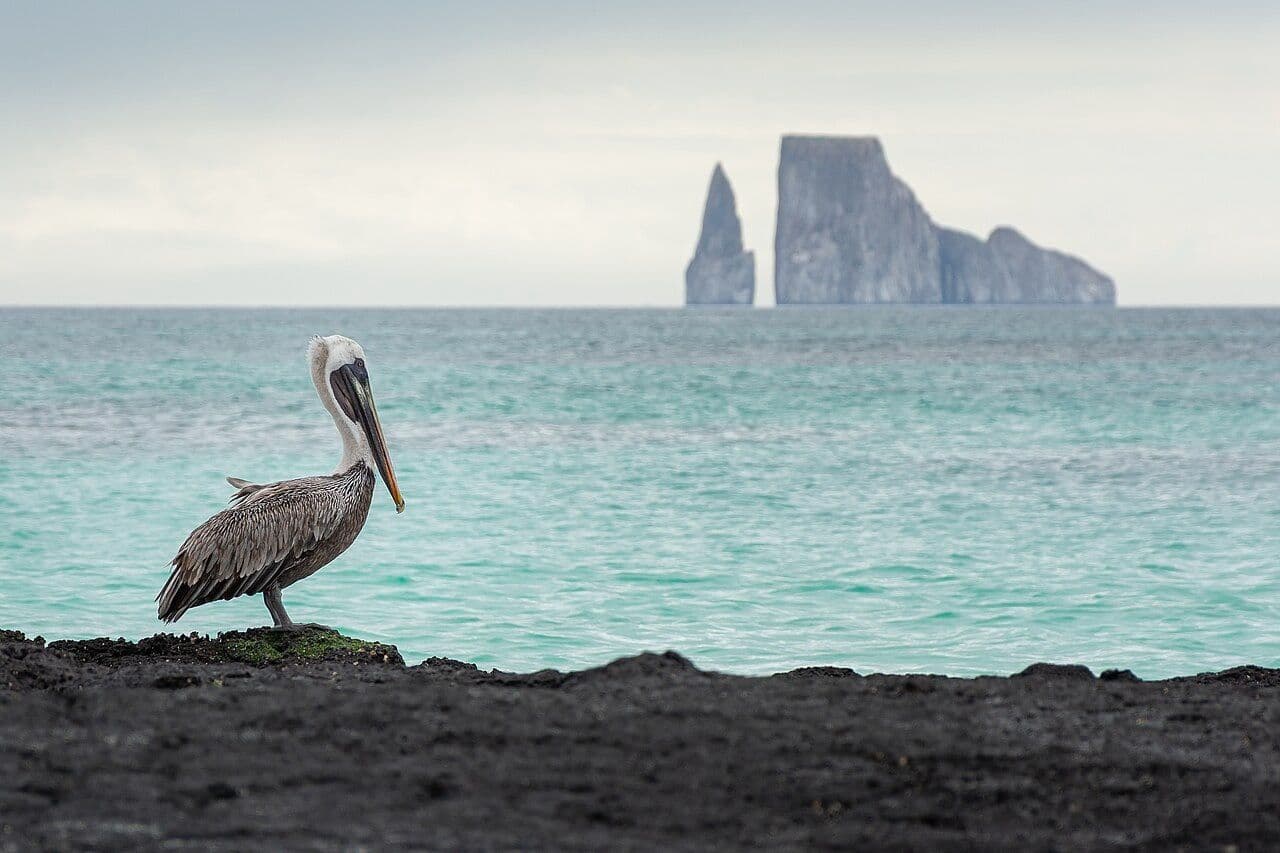
Pelican in Front of Kicker Rock
Photo by kuhnmi, CC BY 2.0, via Wikimedia Commons.
When your destination is Kicker Rock, every detail matters. As a travel agency, we use our Galápagos tours to help you decide what is best for you and design a multiday itinerary in the archipelago that matches your expectations. Everything will be organized so you can enjoy the experience with peace of mind, supported by our highly experienced team and thousands of travelers who have shared positive reviews of their tours.
Contact us, we are the best choice for exploring Galápagos! Also, remember to read our guide to things to do on San Cristóbal, and see how the island compares with its neighbor in our Santa Cruz guide.