17 Things to Do on Santa Cruz Island (with Map)
If the Galápagos had a heart, it would definitely beat on Santa Cruz Island. Thanks to its strategic location in the center of the archipelago, this island has become the nerve center of everything that happens in the Galápagos. It is the most populated island in the province, the tourism epicenter, and for many travelers, the gateway to this natural paradise. Most commercial flights arriving from the mainland land here, and a large portion of the cruises that explore the islands depart from its docks.
In short, if you are planning your Galápagos adventure, chances are everything will begin, and maybe end, on Santa Cruz. And trust me, there could not be a better starting point. If you are planning your adventure to this destination, save this article because it is going to save your itinerary.
Here we tell you exactly what to do once you set foot on the island. We put together a list of 17 must-do activities ranging from the iconic Tortuga Bay to the natural pools of Las Grietas, not to mention the magical moment of seeing giant tortoises roaming free at Rancho Primicias. The best part? Most of these activities are free and you can easily do them from Puerto Ayora, the largest and most vibrant town in the archipelago.
Plus, this guide is updated for 2026 and includes everything you need: costs, recommended times, how to get to each place, how to get around the island, a clear price table, and answers to the questions we all ask before traveling to the Galápagos. In short: less stress, more adventure.
Tortuga Bay. Cover photo by David Ceballos on flickr.
How to Get to Santa Cruz Island
To get to Santa Cruz you need to fly to Baltra (GPS) from Quito or Guayaquil. The approximate cost of a round-trip flight is 250 USD to 400 USD. After that, you need to take a bus (5 USD) and ferry (1 USD) to the Itabaca Channel, then a shared taxi (5-7 USD per person) or a private transfer to Puerto Ayora (15 USD per person). The approximate travel time from Baltra Airport to Puerto Ayora, the cantonal capital of the Santa Cruz canton and the largest, most populated city in the Galápagos province, is 1.5 hours.
The process is straightforward but involves several steps. Upon landing in Baltra, an airport bus takes you to the Itabaca Channel in 10 minutes. There you cross by ferry (5 minutes, 1 USD) and on the other side you take a shared pickup taxi to Puerto Ayora. The ride takes about 45 minutes along a road that crosses the highlands of the island, from which you will be able to see endemic vegetation and, with any luck, giant tortoises along the way.
Alternatively, if you are on San Cristóbal Island and want to travel to Santa Cruz Island, you can do so by speedboat. This trip costs 35 USD and takes approximately 2 hours. Boats depart daily at 7:00 AM from the Puerto Baquerizo Moreno dock.
We invite you to read our complete guide with prices on how to get to Santa Cruz, Galápagos. In it, you will find all the information you need to reach this destination.
Things to Do on Santa Cruz Island
These are the 17 best things to do on Santa Cruz, Galápagos, organized so you can build your itinerary based on your available days and budget. Each activity includes cost, time, and how to get there from Puerto Ayora.
1. Charles Darwin Research Station#
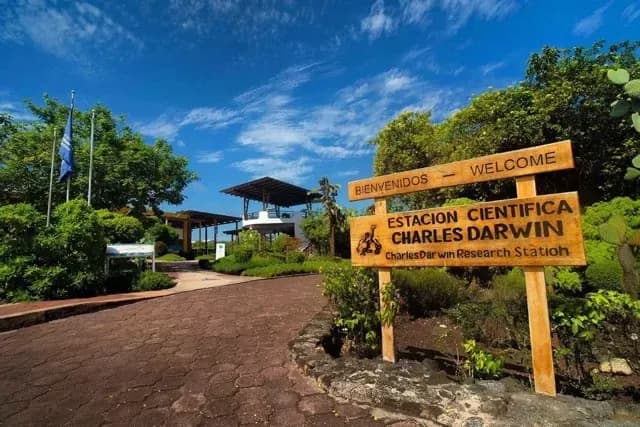
Charles Darwin Research Station Photo by @charlesdarwinfoundation on Instagram.
A visit you cannot skip if you are in Puerto Ayora is the Charles Darwin Research Station (CDRS), considered the operational arm of the Charles Darwin Foundation (CDF). This site is especially important because "the mission of the Charles Darwin Foundation and its Research Station is to provide knowledge and support through scientific research and complementary actions to ensure the conservation of the environment and biodiversity of the Galápagos Archipelago" (Charles Darwin Foundation, 2022).
The Charles Darwin Research Station "has worked on conservation, restoration, and sustainable development projects to ensure proper management of the archipelago. More than a hundred scientists, educators, research assistants, support staff, and volunteers from around the world have participated in this effort" (Charles Darwin Foundation, 2022).
Once at the station, we recommend visiting the natural history specimen collections of the Galápagos and the Charles Darwin exhibition hall where "you will find extensive information on nearly 60 years of scientific research in the archipelago," [and] an enormous and impressive skeleton of a Bryde's whale" (Charles Darwin Foundation, 2022). Additionally, on the station grounds you will find the statue of Charles Darwin, perfect for a photo opportunity.
The Charles Darwin Research Station also features a lookout point, a café, a library, and native gardens. It is located a short distance from downtown Puerto Ayora and is open to the public Monday through Sunday, from 8:00 AM to 6:00 PM. The site operates every day of the year, including holidays. You can get there on foot, by bicycle, or through a private tour.
Admission is completely free, making it an excellent option to enjoy without worrying about your budget.
The visit takes approximately 1.5 to 2 hours, during which you can explore the site at your own pace and take advantage of every space without rushing. The station is located on Av. Charles Darwin s/n in Puerto Ayora, easily accessible from any part of town, and just a 20-minute walk from the dock. The route is simple and low-difficulty, ideal for all types of travelers.
2. The Tortoise Trail#
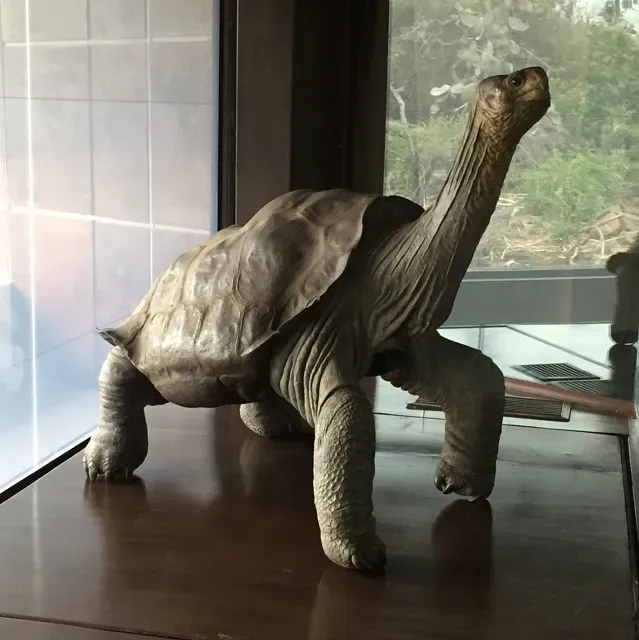
Lonesome George Photo by @lizardorz on Instagram.
The Tortoise Trail, or Ruta de la Tortuga, is a self-guided tourist trail showcasing the evolution, conservation, and breeding of giant tortoises, located within the protected area of Galápagos National Park.
This trail leads to the Fausto Llerena Giant Tortoise Breeding Center, where you can observe the growth process of land tortoises, and to the "Symbol of Hope" hall, where the taxidermied body of Lonesome George is on display, a giant male tortoise from Pinta Island, "who was one of the most famous reptiles in the world for being the last surviving individual of the species Chelonoidis abingdoni" (Charles Darwin Foundation, Remembering the Story of Lonesome George in the Galápagos Islands, 2022).
Lonesome George became an iconic species for the Galápagos and the world. He "died in June 2012 of natural causes and after his death was taken to New York where he was embalmed and then remained on display at the American Museum of Natural History until September 2014. Four years after his death, George returns to the place where he spent his final years and will be exhibited as the centerpiece of the new interpretive trail by the Galápagos National Park Directorate called 'The Tortoise Trail.' Lonesome George is a clear example of the effects that human impact has caused on various species; however, he also represents science's effort to protect those that remain" (Charles Darwin Foundation, Remembering the Story of Lonesome George in the Galápagos Islands, 2022).
Along the Tortoise Trail you will find "a path with treated wooden walkways and volcanic stone pathways, guiding visitors through four interpretive halls with the themes: Everything Changes; Curious Traveler; New Travelers; and Giant Tortoises" (Ministry of Tourism of Ecuador, Minister of the Environment Inaugurates New "The Tortoise Trail" Path, 2022). The trail culminates with the display of Lonesome George's embalmed body in the Symbol of Hope hall.
The experience costs 10 USD per person and is conducted in the company of an authorized naturalist guide, making the visit much more enriching than a simple walk. Over the course of 1.5 to 2 hours, you can explore the site at your own pace, learn about the environment, and enjoy that special connection with nature that makes Santa Cruz Island truly unique.
To get there from Puerto Ayora, simply head to the Charles Darwin Research Station (CDRS) and continue along the coastal trail, a pleasant walk that is part of the experience. The route is low-difficulty, perfect for all types of travelers who want to explore without much effort. You can get there on foot, by bicycle, or through a private tour. You set the pace; nature takes care of the show.
3. Playa de la Estación (Station Beach)#
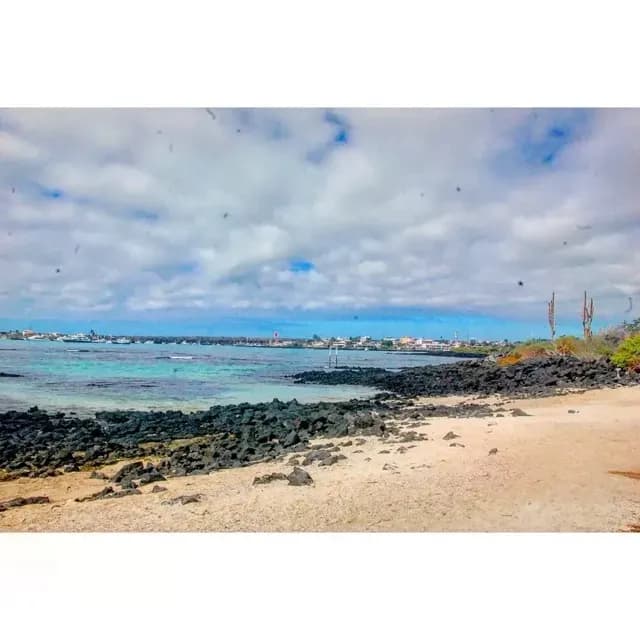
Playa de la Estación Photo by @autenticaviajera on Instagram.
This beach, popular with both tourists and locals, is located next to the Charles Darwin Research Station (CDRS) and Galápagos National Park. It is surrounded by mangroves and volcanic rocks, with a surface area of approximately 3,230 sq ft (300 m²). Here you can find the famous Galápagos manchineel tree, known for producing a toxic white liquid, which is why we recommend not touching its leaves or eating its fruit.
Playa de la Estación is an ideal spot for swimming and snorkeling, where you can see species such as parrotfish, rays, sea turtles, and iguanas. You can reach this beach on a private tour or on your own, either on foot or by bicycle. The experience is completely free, perfect for enjoying without affecting your travel budget.
Visiting hours are from 7:30 AM to 5:30 PM. We recommend setting aside one to two hours to explore the area at a leisurely pace, take photographs, and immerse yourself in the surroundings. The route is low-difficulty, ideal for all types of travelers who want to explore effortlessly and at their own pace.
4. Tortuga Bay#
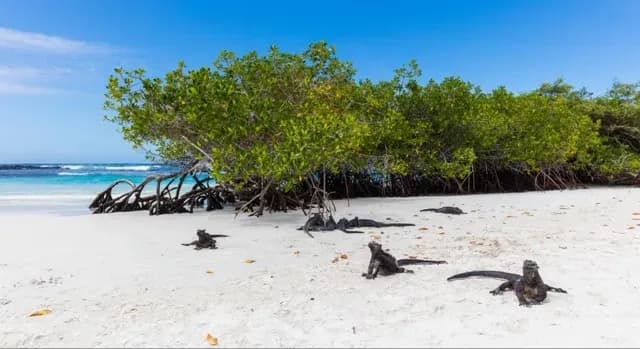
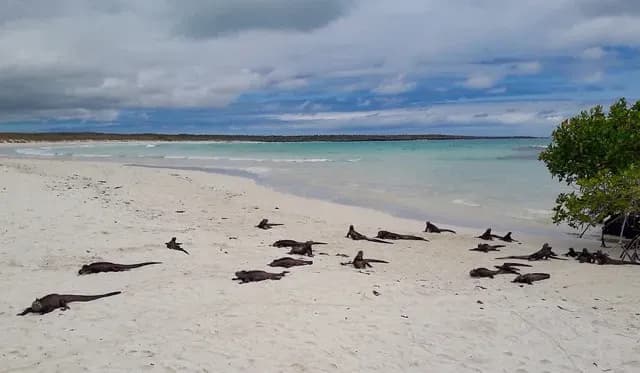
Marine iguanas (Amblyrhynchus cristatus), Tortuga Bay, Santa Cruz Island, Galápagos Islands. Photo by Diego Delso, delso.photo, License CC-BY-SA, via Wikimedia Commons.
If there is one postcard image that defines Santa Cruz Island, it is Tortuga Bay. And yes, you have to go. White sand, turquoise water, and the feeling of being in a nature documentary, but in real life. Here you can sunbathe, swim, surf, snorkel, or kayak. It is, without exaggeration, the most famous beach in the Galápagos, and once you see it, you will understand why.
But Tortuga Bay is not just a beautiful beach. It is also a wildlife spectacle where you can spot marine iguanas, lava gulls, colorful crabs, ground finches, sea lions, and, if you are lucky, sea turtles and whitetip reef sharks near the shore. Behind the mangroves, the salt lagoon sometimes offers another surprise: flamingos. And the name is no coincidence; the iconic black sea turtle nests here.
The beach is divided into two zones with very different personalities:
- Playa Brava, with strong currents and perfect waves for surfers.
- Playa Mansa, much calmer, ideal for swimming, snorkeling, or kayaking among the mangroves.
Getting there is part of the experience. Tortuga Bay is located on the southern coast of Santa Cruz Island. From Puerto Ayora you can walk about 40 minutes (1.5 miles / 2.5 km) to reach Playa Brava. The trail is paved, flat, and easy, and along the way you will enjoy an ancient lava field colonized by palo santo trees and Opuntia cacti. Or if you prefer, you can take a water taxi from the Puerto Ayora docks to save energy.
Admission to the beach is free and hours are from 6:00 AM to 6:00 PM. Before starting the walk, you must register at the Galápagos National Park booth. Remember to keep at least 6.5 feet (2 meters) from the animals, leave no trash, and respect all park rules. Here, we are guests in someone else's home.
Travel tip: Bring water, snacks, sunscreen, bug spray, a towel, a hat, and athletic shoes. The sun is unforgiving, but the reward is absolutely worth it.
Set aside three to four hours to enjoy the full visit, including the round-trip walk. Between the hike, the wildlife, and the time you will inevitably want to spend staring at the sea, Tortuga Bay becomes more than just a beach visit: it is an experience that stays with you long after you leave.
5. Las Grietas#
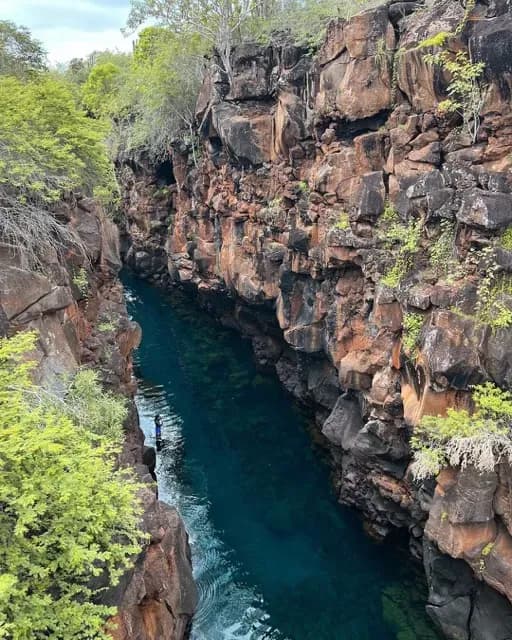
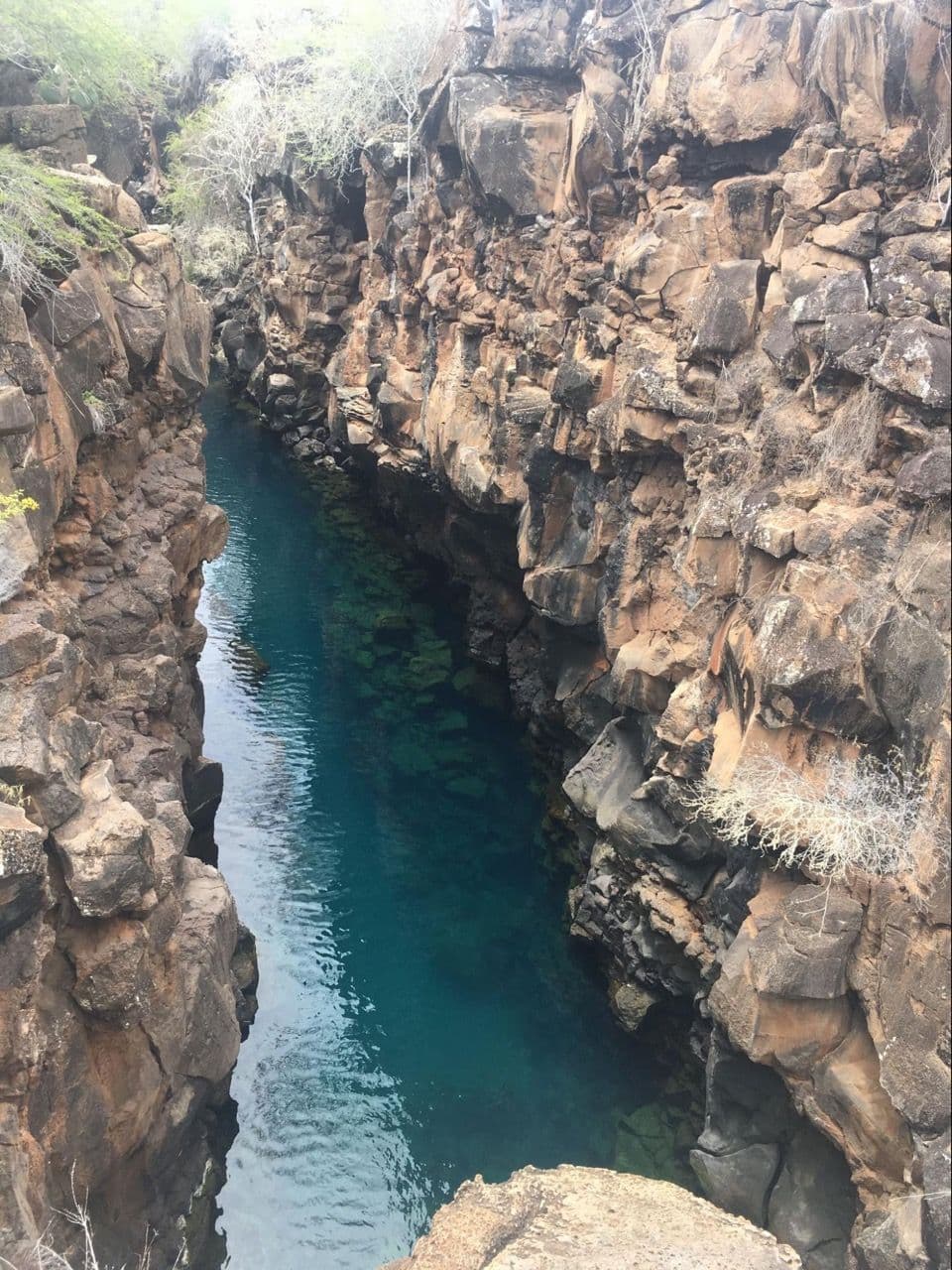
Las Grietas Photo by @aroundthe7seas on Instagram.
Las Grietas are volcanic rock walls where the sea flows in. The water is a mix of seawater entering from one end and freshwater filtering through from the other. These natural pools are ideal for swimming or snorkeling while surrounded by an unusual and unique landscape.
This site is located 1.9 miles (3 km) from Puerto Ayora, west of Academy Bay (Bahía Academia). To get there, take a water taxi for just 1 USD from the municipal dock on Santa Cruz Island to a private hotel dock. From the hotel, follow the signposted trail toward Las Grietas. You will walk approximately 20 minutes along a path that passes by saltwater lagoons. Finally, you will find wooden steps leading directly to the inviting waters.
You can go with a tour guide or on your own. Admission to Las Grietas has a mandatory cost of 10 USD per person for tourists (domestic and international), which includes an authorized Galápagos National Park guide.
We also recommend not bringing too many things with you; a swimsuit, sunscreen, a towel, and some cash will be enough to enjoy a relaxing and refreshing swim.
Visiting Las Grietas is a half-day activity, an important detail to keep in mind when planning your visit. Arrive before 9:00 AM to avoid the lines from the capacity control system in place since 2023. The route is moderately difficult, ideal for those who want to combine a light hike with the reward of a swim in one of the most fascinating natural settings in the Galápagos. A perfect spot for swimming in refreshing waters, admiring the contrasts of light filtering through the rocks, and capturing unforgettable photos.
6. Playa El Garrapatero#
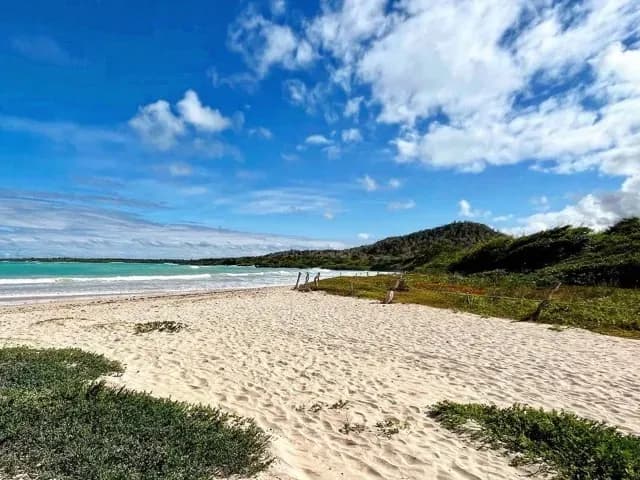
Playa El Garrapatero Photo by @esserecomeloro on Instagram.
Another beach on Santa Cruz Island that we recommend visiting is Playa El Garrapatero. It is located on the east coast of Santa Cruz Island, northeast of Puerto Ayora. This beach sits in the rural area of the Bellavista parish via Cascajo, and the trailhead is 11.8 miles (19 km) from town. The beach stretches nearly 1 mile (1.5 km) and is surrounded by mangroves; it is ideal for those who seek tranquility and for anyone looking to snorkel, kayak, or camp.
In fact, Playa El Garrapatero is one of the few sites where the Galápagos National Park Directorate allows camping. Keep in mind that you need to obtain a camping permit through the Galápagos National Park Directorate.
You can head to Playa El Garrapatero on your own or with a tour guide. If going on your own, a taxi can take you from Puerto Ayora to the trailhead, and later come back to pick you up. From the trailhead, it is a 15-minute walk to the beach. The exact distance is 2,850 feet (870 meters). Along the way you will see candelabra cacti, palo santo, muyuyo, and other species. You can also rent a bicycle. Once you reach the parking area near the beach, you will need to walk a short stretch to reach the beach itself. The path is relatively easy and takes you through a beautiful natural setting.
Keep in mind that in the Galápagos, regardless of which beach you visit, you will enjoy unparalleled flora and fauna, and El Garrapatero is no exception. Ghost crabs, resident and migratory seabirds, flamingos, iguanas, and other species will accompany you during your visit. Also remember that Playa El Garrapatero is a pristine natural area with no tourist facilities, so you need to bring your own supplies.
Admission to Playa El Garrapatero is free, making it an excellent option for those looking to explore without affecting their budget. We recommend setting aside two to three hours to explore at a leisurely pace, take photographs, and enjoy the natural surroundings. With its easy difficulty level, it is an ideal activity for all types of travelers: families, couples, or adventurers looking for an accessible and enjoyable experience amid the wonders of the Galápagos.
7. Santa Cruz Highlands, Galápagos Giant Tortoises, and Rancho Primicias#
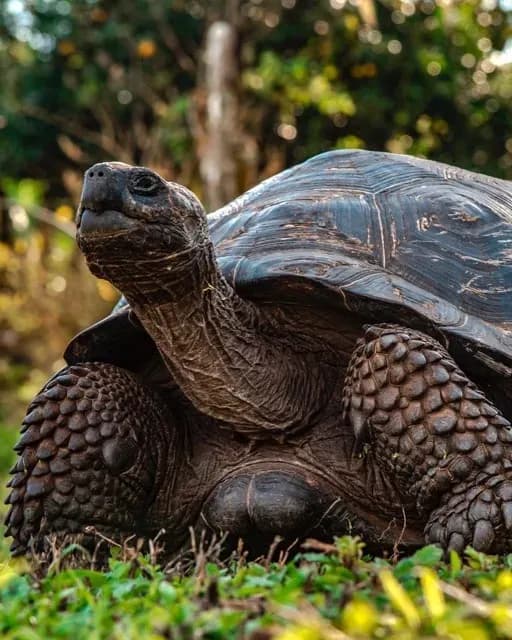
Galápagos giant tortoise in its natural habitat Photo by Rancho Primicias on Facebook.
If you are still wondering what to do on Santa Cruz Island, we recommend visiting the well-known Rancho Primicias. Located in the Santa Rosa parish, Rancho Primicias is a nature reserve situated 30 minutes from Puerto Ayora in the island's highlands. This site attracts thousands of tourists every year because it offers the chance to observe giant tortoises in their natural habitat.
You can take photos inside the giant tortoise shells, enjoy the on-site restaurant, or purchase a variety of agroecological and organic products sold under the Primicias brand.
You can also walk through a 1,312-foot (400-meter) lava tunnel. The lava tunnels on Santa Cruz formed when the outer layer of molten lava from volcanic eruptions solidified, but the liquid magma inside continued flowing, leaving behind a series of empty tubes. Visitors can walk through these underground channels and may have the chance to see the owls that live inside.
You can reach this site by taxi or through a tour package with a travel agency. Some tours include visits to Rancho Primicias, Los Gemelos, and the impressive lava tunnels, and last approximately three hours. The difficulty level is easy, ideal for all types of travelers.
Exploring the highlands from Puerto Ayora is one of those moments that define a trip to the Galápagos. Amid the vegetation, the giant tortoises suddenly appear: immense shells that look like living boulders advancing with ancient calm. You hear the soft scrape of their feet on the grass, the crunch of their chewing, their slow breathing. Some rest in mud puddles; others walk along, indifferent to the awe they inspire. Standing before them is not just a visit: it is a genuine journey through time, an intimate encounter with one of the archipelago's most iconic species.
8. Los Gemelos#
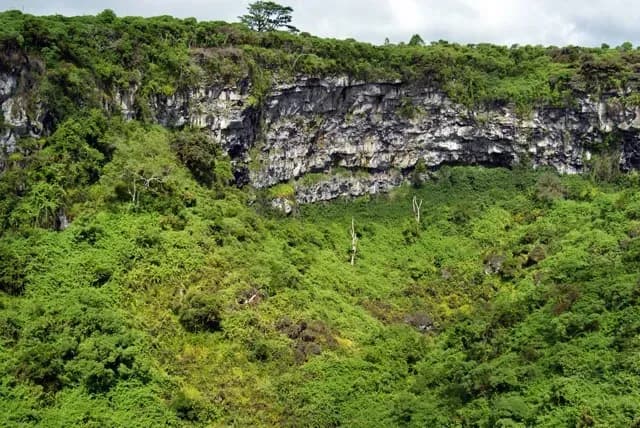
Los Gemelos Photo by Dallas Krentzel, CC BY 2.0, via Wikimedia Commons.
We believe that during your visit to Santa Cruz you should see Los Gemelos (The Twins), one of the most important natural attractions in the Galápagos. Los Gemelos are located in the rural highlands of Santa Cruz, in the Santa Rosa parish, along the Puerto Ayora-Itabaca Channel road.
Los Gemelos are two large depressions of volcanic material, named as such because they are formations located directly across from each other, separated by the road. They were formed through a prolonged process of gradual land subsidence and are the product of a series of eruptions during the time when the island was still an active volcano. Geologically speaking, they are known as pit craters.
It is worth noting that this is the only place on the island surrounded by a native Scalesia forest. Additionally, several species of land birds inhabit the area, including the famous vermilion flycatcher.
You can visit this site with a tour guide or on your own. If going on your own, you can take a taxi from Puerto Ayora, or if your physical condition allows, you can make the trip by bicycle. The route covers 13 miles (21 km) and there is a bike lane for that purpose. Admission is free and visiting hours are from 7:30 AM to 5:30 PM.
This activity is free and takes approximately 30 to 45 minutes, perfect for a brief but enriching visit. However, if you decide to combine it with a tour of Rancho Primicias, the impressive lava tunnels, and Los Gemelos, in just two to three hours you can enjoy a complete experience in the island's highlands.
It will be a journey full of nature, surprising geological formations, and unforgettable wildlife encounters, an adventure that is accessible, fascinating, and deeply authentic.
9. Laguna de las Ninfas (Nymphs Lagoon)#
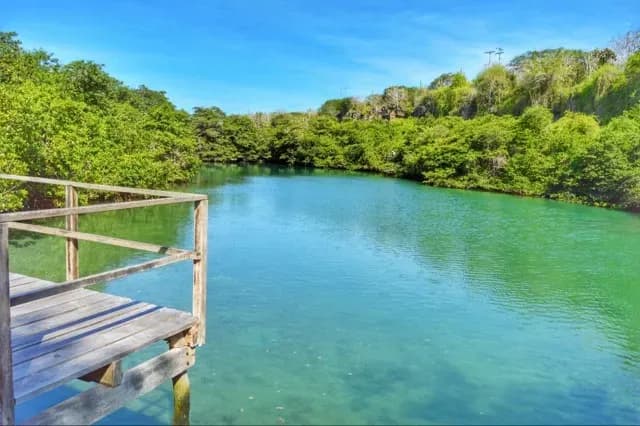
Laguna de las Ninfas Photo by Yolo Ecuador on flickr.
Another thing to do on Santa Cruz Island is visit Laguna de las Ninfas. Located within the urban area of Santa Cruz, this is a site of particular beauty that surprises visitors as a true haven of peace. Laguna de las Ninfas is a saltwater lagoon explored via a wooden boardwalk, a structure that allows you to enjoy the beauty of the surroundings.
The lagoon is surrounded by two of the four mangrove species found in the Galápagos Islands, specifically white mangrove and red mangrove. It is open to the public, admission is free, and you can visit during the day, as nighttime entry is prohibited.
With a recommended duration of 30 to 45 minutes, this walk allows you to disconnect from the hustle and bustle of the town center while enjoying a nearby and accessible natural environment. The route is easy, ideal for all types of visitors: families, couples, or travelers seeking a relaxed and enjoyable plan amid the charms of the Galápagos. It is the perfect option for those who want a short but memorable visit, enjoying the scenery and the tranquility this part of the archipelago offers.
10. Fishermen's Dock (Muelle de los Pescadores)#
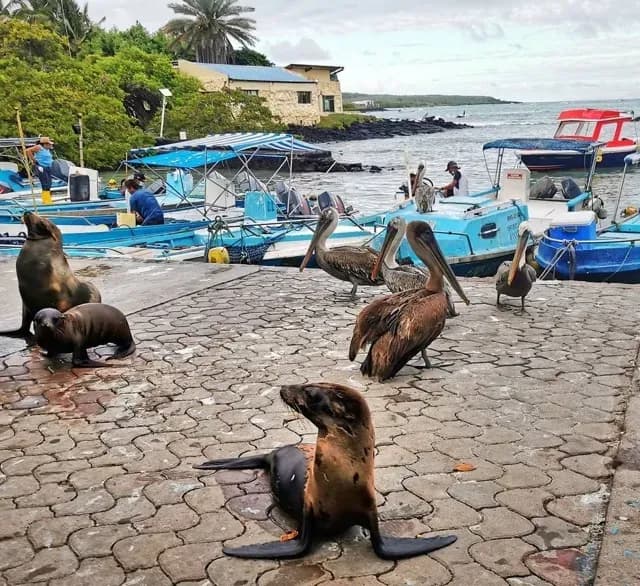
Fishermen's Dock Photo by @mr7eth on Instagram.
Another thing to do on Santa Cruz Island is visit the famous Fishermen's Dock. This "is located in the Pelican Bay neighborhood, along the main tourist artery of Avenida Charles Darwin, half a kilometer from the Gus Angermeyer Tourist Dock [...]. At the Fishermen's Dock, you can enjoy fresh seafood products ready for sale, harvested through artisanal fishing activities permitted in the Marine Reserve" (GAD Municipal de Santa Cruz, 2022).
This is a great place to admire the dedicated work of the fishermen, and a perfect spot to see sea lions, pelicans, herons, frigatebirds, gulls, and more. Many tourists visit this site year-round due to the large concentration of animals that gather here and refuse to leave until they snag a coveted bite of food.
The visit, completely free, invites travelers to enjoy a relaxed stroll of 30 minutes to an hour while watching the boats gently swaying in the water and the comings and goings of fishermen continuing their traditional work.
The route is easy, ideal for families, couples, or visitors seeking a calm and authentic experience in the heart of the Galápagos. Besides being an excellent vantage point for admiring marine life and capturing memorable photographs, the dock serves as a perfect starting point for exploring the waterfront, visiting the fish market, and immersing yourself in the local culture of Puerto Ayora.
11. Playa Las Bachas#
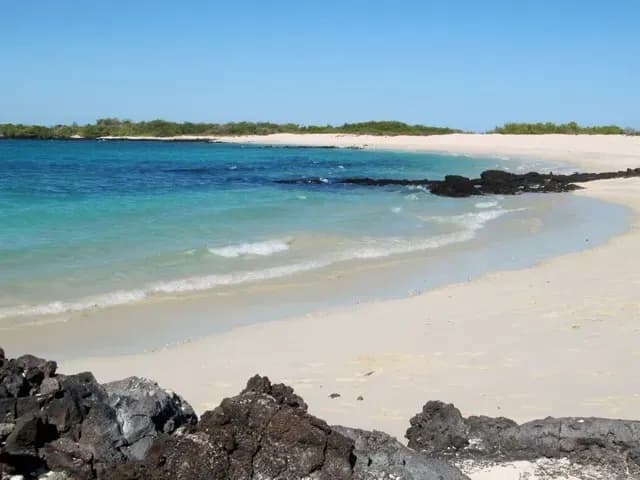
Playa Las Bachas Photo by David Stanley from Nanaimo, Canada, CC BY 2.0.jpg), via Wikimedia Commons.
This beach, like others on Santa Cruz, features crystal-clear waters, white sand, and a calm sea, making it one of the ideal beaches for snorkeling. It is located on the northern coast of Santa Cruz and stretches approximately 0.6 miles (1 km) in length.
This is one of the main sea turtle nesting sites on Santa Cruz Island. Nearby, you can also spot flamingos, shorebirds, migratory birds, and of course, the striking iguanas of this part of the Galápagos.
You can reach Las Bachas either by cruise or on a day tour to North Seymour Island. Keep in mind that this beach must be included in the itinerary of the tour you choose. You can visit Las Bachas Monday through Sunday from 6:00 AM to 6:00 PM. Remember that this beach has no tourist facilities, so you need to bring your own supplies.
If you visit between November and February, you may see nests marked in the sand and, with luck, newly hatched baby turtles making their way to the sea. A fun fact: the name "Bachas" comes from barges, as there are rusted remains of World War II barges in the area from when the U.S. had a military base on Baltra.
12. Playa Punta Estrada (German Beach)#
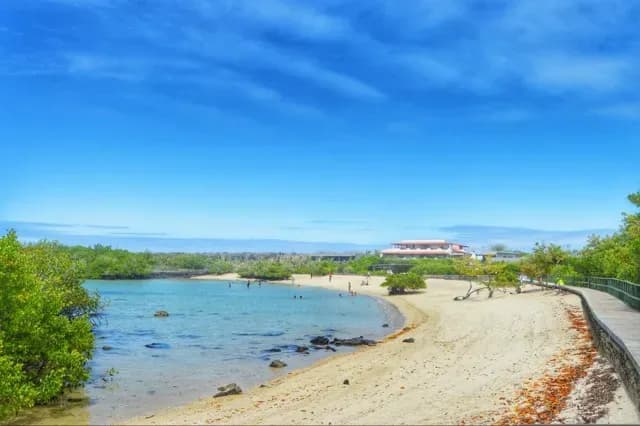
Playa de los Alemanes (German Beach), Santa Cruz Island, Galápagos, Ecuador Photo by Yolo Ecuador on flickr.
Just five minutes from the town of Puerto Ayora, you will find Playa Punta Estrada, better known as Playa de los Alemanes (German Beach), named after the German colony that settled in this area during the colonization era of Santa Cruz Island.
This is a beach with calm, deep turquoise waters and sand of coral and shell origin, surrounded by mangroves; a perfect spot for sunbathing, snorkeling, and relaxing. You can access this beach only by sea, via water taxis (1 USD) departing from the Gus Angermeyer Dock. The boat ride takes approximately 5 minutes; you will arrive at the Punta Estrada dock and find a trail leading to the beach. That is how simply the experience begins.
The visit is completely free, except for the water taxi, and you can dedicate two to three hours to enjoy it at a leisurely pace, take photos, and connect with the surroundings. The difficulty level is easy, ideal for all types of travelers, from those seeking a relaxed outing to those who want to add one more must-see to their list without complications.
If you are in Puerto Ayora and looking for an easy, affordable plan with plenty of charm, this is an excellent option. This beach is very close to the renowned Finch Bay Hotel, and also nearby are Las Grietas, Canal del Amor, and Canal de los Tiburones.
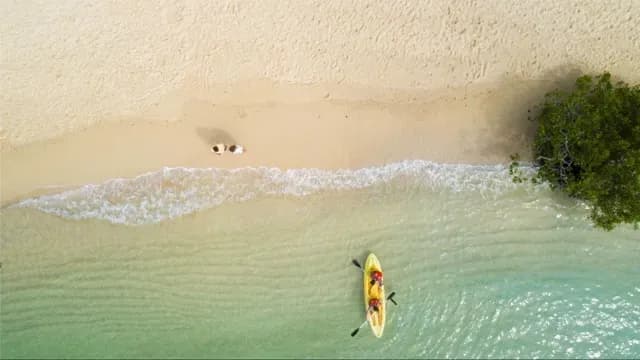
Finch Bay Galápagos Hotel, Puerto Ayora. Photo by the Ministry of Tourism of Ecuador.
13. Canal del Amor (Love Channel)#
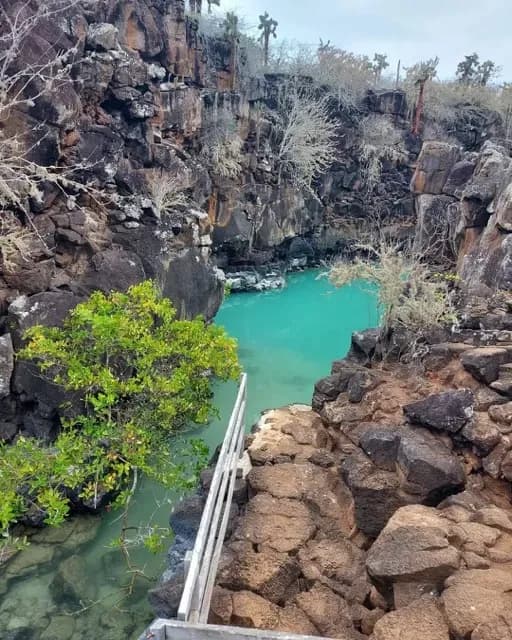
Canal del Amor on Santa Cruz Photo by soyvannemendez on Instagram.
Canal del Amor is one of the most photogenic spots in the Punta Estrada area, southwest of Puerto Ayora. It is a narrow channel of crystal-clear waters surrounded by volcanic rock formations where you can snorkel among marine iguanas, whitetip reef sharks, and colorful tropical fish. If you are lucky, you will see blue-footed boobies perched on the channel rocks. The difficulty is easy to moderate, ideal for those who enjoy combining exploration and ocean.
Spending 30 to 45 minutes at this spot is enough to be swept up by its intimate and quiet atmosphere. Between reflections of light on the water and small marine species gliding beneath the surface, the place invites you to disconnect and simply float.
Canal del Amor is a must-stop on the Bay Tour, a tour included in all of our Galápagos tours. The tour departs from the Puerto Ayora dock and visits several points around Academy Bay, including Canal del Amor, Canal de los Tiburones, and Playa de los Perros. Most operators include snorkel gear in the price.
14. Canal de los Tiburones (Shark Channel)#
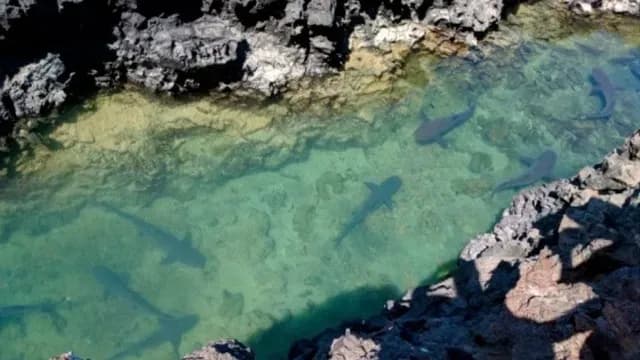
Canal de los Tiburones Photo by the Directorate of Productive and Sustainable Development of GAD de Santa Cruz on their website.
If the idea of swimming with sharks does not appeal to you, Canal de los Tiburones is your perfect alternative. This natural viewpoint near Punta Estrada allows you to observe whitetip reef sharks resting in a volcanic rock channel, all from dry land and just a few feet away.
The channel is shallow and the calm waters make the sharks perfectly visible from above. It is also common to see rays, marine iguanas, and sea lions in the area. The best times to see them are usually in the morning or early afternoon, when the light enters the water more clearly.
The visit is usually part of the popular Bay Tour on Santa Cruz Island, a tour included in all of our Galápagos tours. You can also walk there from Punta Estrada if you prefer to go on your own (25-minute walk).
You can dedicate about 20 to 30 minutes to this stop. Access is easy and low-difficulty, making it a perfect stop for those who want to observe sharks up close without needing to get in the water.
15. Playa de los Perros (Dog Beach)#
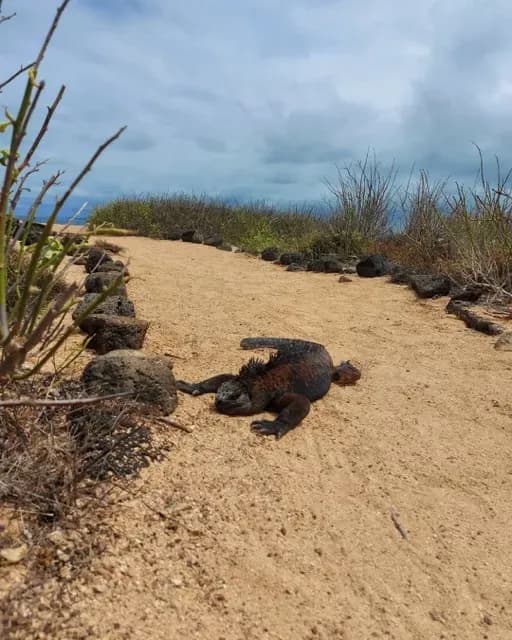
Playa de los Perros on Santa Cruz Photo by soyvannemendez on Instagram.
Playa de los Perros is a small coral beach of about 245 feet (75 meters), perfect for a quiet morning away from the bustle of Puerto Ayora. A visit to Playa de los Perros is usually part of the popular Bay Tour on Santa Cruz Island, an excursion included in all our Galápagos tours.
Or if you prefer to go on your own, from the Puerto Ayora dock you take a water taxi that, for just 1 dollar, crosses the bay in about eight minutes. Upon disembarking, a trail of approximately 1,650 feet (505 meters) winds through volcanic rock and coastal vegetation. The path is somewhat uneven but accessible for most travelers and adds that touch of exploration that makes the arrival special.
When you arrive, you will find dozens of marine iguanas sunbathing on the black rocks, sea lions resting on the sand, and ideal waters for snorkeling. Bring your own gear because there is no rental available on-site. The trail has no shade, so sunscreen and water are essential.
16. Bahía Ballena (Whale Bay)#
Bahía Ballena, or Whale Bay, located on the west coast of Santa Cruz Island, is a historic cove with a green sand beach at the base of Cerro Ballena. It is one of the oldest whaling camps on the island. In the past, this and similar camps were where giant tortoises were brought to be loaded aboard whaling and pirate ships as food for later voyages.
One of the most notable features of this bay is the green sand beach, a color produced by the high percentage of olivine crystals originating from volcanic materials.
In the water you will find sea turtles, eagle rays, and schools of tropical fish. The bay is protected, so the water is usually calm with good visibility for snorkeling even if you have no experience. On the land side, there is a short trail where you can spot marine iguanas and coastal birds.
It is less well-known than the main beaches, which means fewer boats and more tranquility. Tours usually combine Bahía Ballena with other nearby visitor sites. It is not accessible on your own, so you need to take a tour to get there.
17. Cerro Dragón (Dragon Hill)#
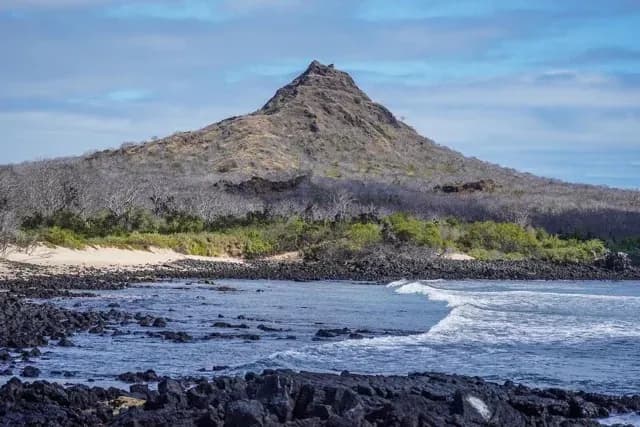
Cerro Dragón Photo by @drbenreyes on Instagram.
Cerro Dragón, or Dragon Hill, located northwest of Santa Cruz Island, "consists of a trail that passes through three different environments in just 1 mile (1,600 meters) of length. It bears this name because in 1975, it was one of the only sites on Santa Cruz Island where land iguanas (Conolophus subcristatus) were found in a healthy state. That same year, the Galápagos National Park and the Charles Darwin Foundation launched a land iguana conservation program. [...] Cerro Dragón has been open for tourism since 1993" (Galápagos National Park Directorate, Cerro Dragón, 2016).
At this site, you can also see flamingos, Galápagos finches, yellow warblers, boobies, and frigatebirds. It is not accessible on your own, so you need to take a tour to reach this destination. Before or after the hike, most tours include a snorkeling stop in the bay in front of Cerro Dragón. The snorkeling here is among the best on the island: sea turtles, rays, and if you are lucky, whitetip reef sharks.
Costs and Prices on Santa Cruz 2026#
Visiting Santa Cruz costs from 50 USD/day (backpacker) to $300+/day (luxury tourism). These are the main costs to keep in mind when planning your budget. Remember that these are reference prices subject to change.
Item | 2026 Price
- National Park Entrance (foreign adult) — 200 USD
- Transit Control Card (TCT) — 20 USD
- Taxi airport → Puerto Ayora — 25-30 USD (shared 5/7.5 USD/person)
- Water taxi (dock) — 1 USD
- Local lunches — 4-5 USD
- Tourist restaurants — 10-20 USD
- Budget hostel — 15-30 USD/night
- Mid-range hotel — 60-120 USD/night
- Day tour (nearby islands) — 135-230 USD
- Bay Tour (half day) — 30 USD
The biggest expenses of your Galápagos trip are usually the Galápagos National Park entrance fee and the flights. Once on the island, you can keep costs low: eat at local spots and take advantage of the free activities on this list. Tours to nearby islands like Bartolomé Island, North Seymour Island, or Santa Fe Island are more expensive; however, they offer unique experiences that make every dollar worth it.
Need help planning your budget? Contact us on WhatsApp.
How to Get Around Santa Cruz#
Puerto Ayora is easily walkable; most activities are within a 30-minute walk. For the highlands (giant tortoises, Los Gemelos), you will need a taxi, inter-parish bus, or you can rent a bicycle. Water taxis to the dock cost 1 USD. Additionally, if you prefer getting around by bicycle, there are many places where you can rent one for the day.
On foot: The waterfront, the Charles Darwin Research Station, Laguna de las Ninfas, the Fishermen's Dock, Playa de la Estación, and Tortuga Bay are all within walking distance. Puerto Ayora is compact and safe for walking day and night.
Taxis: These are pickup-style trucks. To go to the highlands (Rancho Primicias, Los Gemelos, lava tunnels), the standard price is $20-25 for the entire taxi, not per person. To El Garrapatero, ~$15 one way. There is no meter; negotiate the price before getting in.
Water taxi: From the main dock to Angermeyer Point (for Las Grietas, Playa de los Alemanes). These cost 1 USD per person and operate all day.
Bicycle: Some shops in Puerto Ayora rent bicycles (10-15 USD/day). Useful for getting around town but not recommended for the highlands due to the distance and heat.
There is no public bus within Puerto Ayora. Buses only cover the Puerto Ayora-Itabaca Channel route (to reach Baltra Airport) and inter-parish/rural transport departing from Av. Baltra in Puerto Ayora (across from the Municipal Market) to the highland parishes, such as Santa Rosa and Bellavista.
Frequently Asked Questions#
How much time do you need to spend on Santa Cruz Island?
A minimum of 3 days for the main activities (Tortuga Bay, Las Grietas, Charles Darwin Research Station, highlands). Ideal: 5-7 days to explore everything at a relaxed pace and include tours to nearby islands like Bartolomé or North Seymour.
What is the best time to visit Santa Cruz?
The Galápagos has two seasons: warm-wet (January to May, warmer water, better snorkeling) and cool-dry (June to December, more wildlife, rougher seas). Santa Cruz can be visited year-round. Peak season is July-August and December-January.
We recommend checking our article on the best time to visit the Galápagos, so you can discover the ideal time for that long-awaited trip to the second-largest marine reserve on the planet, declared a UNESCO World Heritage Site in 1978.
How much does it cost to visit Santa Cruz, Galápagos?
Backpacker budget: 50-80 USD/day. Mid-range budget: 100-200 USD/day. Comfort budget: 200-400 USD/day. Additionally, you must factor in the National Park entrance fee: 200 USD (foreign adults) + 20 USD Transit Control Card (TCT).
How do you get to Santa Cruz from Baltra Airport?
Bus from the airport to the Itabaca Channel (5 USD) → ferry (1 USD) → shared taxi to Puerto Ayora (25-30 USD). Total: ~1.5 hours, ~$11 per person.
How do you get around Santa Cruz?
Puerto Ayora is walkable. For the highlands, there are pickup-style taxis that charge 20-25 USD for a 3-hour route (Rancho Primicias + Los Gemelos + lava tunnels). The water taxi to the dock costs 1 USD.
What is Santa Cruz Island known for?
Santa Cruz, after Isabela Island, is the second-largest island in the archipelago and the most inhabited of the Galápagos Islands. Santa Cruz Island is the main economic hub of the islands and a key strategic point for exploring the archipelago. Puerto Ayora is the cantonal capital of the Santa Cruz canton, as well as the largest and most populated city in the Galápagos province. It is known as "The Heart of the Galápagos" for being the archipelago's economic center and for its privileged geographic location.
What free activities are there on Santa Cruz?
Most activities are free: Tortuga Bay, Las Grietas, Charles Darwin Research Station (CDRS), Laguna de las Ninfas, Los Gemelos, Fishermen's Dock, Playa de la Estación, and El Garrapatero. In some cases, you only pay for a taxi.
Can you snorkel without a tour on Santa Cruz?
Yes. The best free spots for snorkeling on your own are Playa de la Estación, Las Grietas, Tortuga Bay (Playa Mansa), and Playa de los Alemanes. Bring your own gear or rent in Puerto Ayora (~5-10 USD/day).
Where can you see giant tortoises in the wild?
In the Santa Cruz highlands: Rancho Primicias is the most popular (5 USD admission), and also at Reserva El Chato. They are 30 minutes by taxi from Puerto Ayora. The tortoises can be seen year-round.
Is it worth visiting Santa Cruz Island?
Absolutely. If you are wondering what makes Santa Cruz Island special, this island has places as paradisiacal as they are unique in the world, making it a must-visit if you have the opportunity to explore the Galápagos Islands. It offers the widest selection of tours, accommodations, and restaurants. It is the ideal base for exploring the archipelago, with free activities and the greatest logistical convenience.
The island boasts highly renowned tourist attractions such as the Charles Darwin Research Station (CDRS), Lonesome George (located on "The Tortoise Trail"), Tortuga Bay, Las Grietas, Los Gemelos, and more.
Remember, you cannot truly say you have experienced the Galápagos Islands if you have not visited Santa Cruz Island.
What animals can you see on Santa Cruz Island?
Galápagos giant tortoises, marine and land iguanas, sea lions, brown pelicans, frigatebirds, Sally Lightfoot crabs, blue-footed boobies, manta rays, whitetip reef sharks, Darwin's finches, and flamingos (at Garrapatero and Bachas).
Where to eat in Puerto Ayora?
In Puerto Ayora, the dining scene stands out for fresh fish such as brujo fish (grilled or fried) and seafood. There are kiosks on Charles Binford Street (fresh seafood 5-10 USD), local restaurants (lunches 4-5 USD), and tourist restaurants on the waterfront (10-20 USD). Be sure to try Puerto Ayora's specialty: grilled lobster (in season September to December, 15-25 USD).
Is it safe to travel solo to Santa Cruz, Galápagos?
Yes, it is very safe to travel solo to Santa Cruz, Galápagos. Puerto Ayora is a tourist-friendly, safe, and welcoming town. The archipelago is considered one of the safest destinations in Latin America, with low crime rates. It is an ideal destination for solo travelers. However, it is recommended to avoid poorly lit or peripheral areas at night.
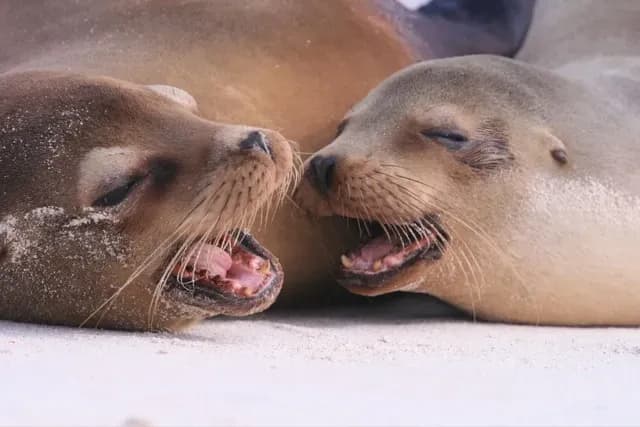
Photo by the Ministry of Tourism of Ecuador.
Puerto Ayora, located on the southern coast of Santa Cruz Island, is the main tourist and economic center of the Galápagos Islands, the heart of this world-famous archipelago, a place travelers prefer because it is the ideal base for discovering things to do in the Galápagos Islands. The island is famous for its bustling commercial activity and a wide, diverse range of establishments and tourist services, and of course, because most cruises depart from here. And now that you know what to do on Santa Cruz Island, are you ready to explore it?
We invite you to discover it in our company. Check out this unique selection of the best tours in the Galápagos; we will provide guidance and ongoing support throughout your trip. Choose your ideal adventure and enjoy a trip planned down to the last detail, with certified naturalist guides and personalized attention.