Las Grietas on Santa Cruz: 2026 Guide to Puerto Ayora's Volcanic Pools
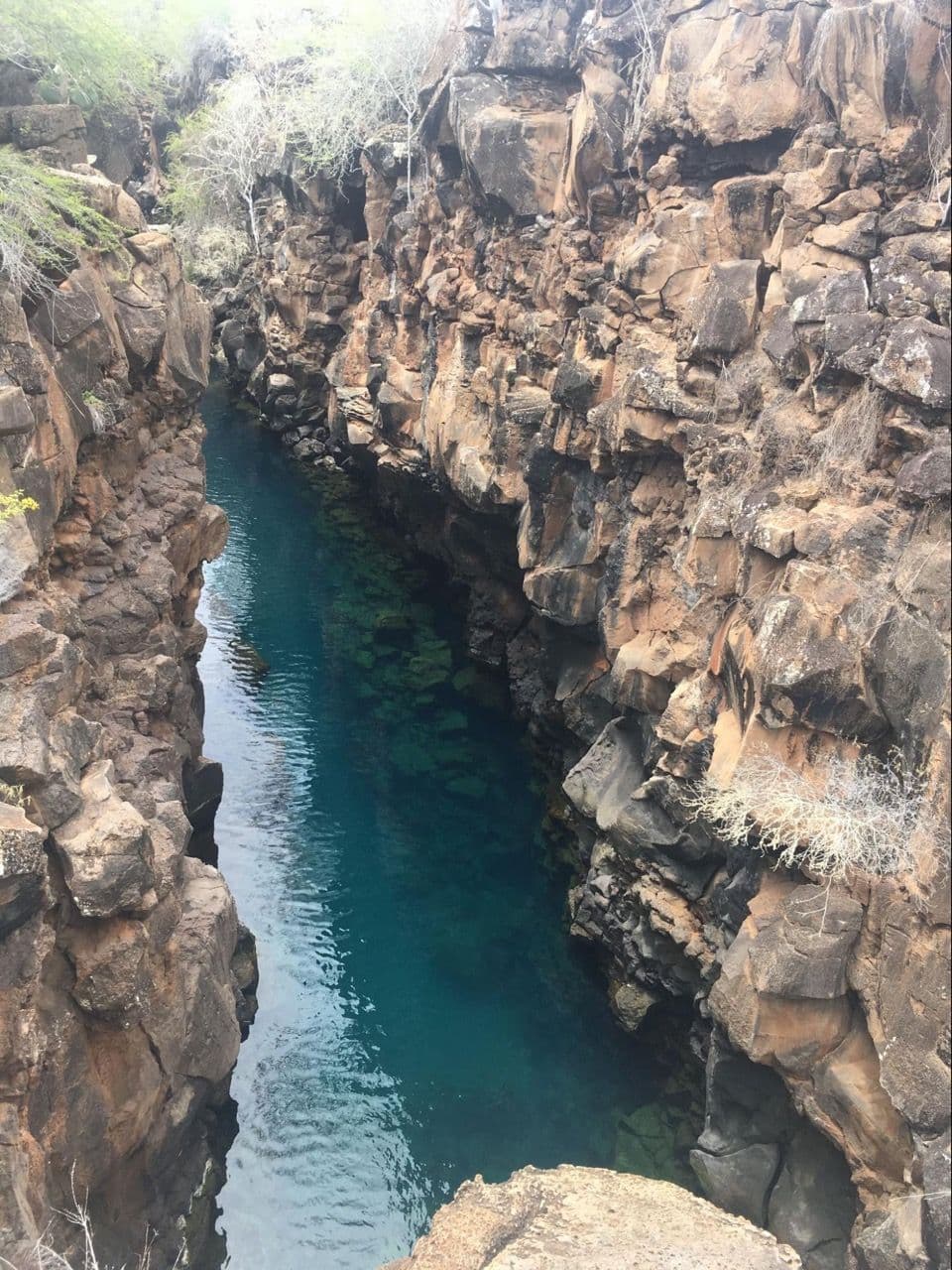
Looking for one of the most amazing places in the Galápagos? Las Grietas, on Santa Cruz Island, awaits with emerald waters, impressive volcanic lava walls, and a swimming experience unlike any other in the archipelago. This site consists of three natural brackish-water pools enclosed by volcanic lava walls, just 1.6 miles (2.5 km) from downtown Puerto Ayora in the Punta Estrada neighborhood of Santa Cruz Island.
Admission is $10 USD per person and includes an authorized Galápagos National Park naturalist guide, a requirement since 2021. The site is open from 7:00 a.m. to 6:00 p.m. New groups enter approximately every two hours and fill up quickly, so we recommend arriving before 9:00 a.m.
If you want to explore a place where the power of nature has created a truly extraordinary landscape, Las Grietas deserves a prominent spot on your Galápagos itinerary. In this guide, you will learn how to get there, how much admission costs, what to see, what to bring, and the best tips for making the most of your visit.
Cover photo: Las Grietas, by María Gabriela Mancheno.
Why Is It Called "Las Grietas"?
The name is literal: "grietas" means cracks or fissures in Spanish, and that is exactly what this site is. A large volcanic fissure about 328 feet (100 m) long, 23 feet (7 m) wide, and 33 feet (10 m) deep opened in the rock of Santa Cruz thousands of years ago. What makes it special is the mixture of water: salt water from the sea enters at one end, while fresh water flows down from the highlands through underground lava tubes. The result is emerald-colored brackish water.
This is not a single pool. It consists of three separate pools connected by rocky sections that visitors climb or swim through, all remnants of the same geological activity that formed the island. The water comes from two opposite sources: fresh water from an underground river that flows from the Santa Cruz highlands through ancient lava tubes enters at one end, while salt water seeps in from Bahía Academia at the other. Where the two meet, they form a brackish mixture, which is why there are almost no sharks or large marine animals here.
The fissure was not carved by water or coastal erosion. It is a fracture in the basalt rock caused by the cooling and tectonic stress of the lava that formed Santa Cruz, a shield volcano. The fissure cuts through the rock layer to the water table, which keeps it flooded year-round.
One practical detail follows from this geology: the pools' water level and salinity rise and fall with the tide in Bahía Academia. At high tide, more seawater enters and the mixture becomes saltier. At low tide, fresh water from the aquifer predominates. As a result, the color and visibility change throughout the day, something worth considering if you plan to snorkel.
Hours, Cost, and Capacity System
Las Grietas is open daily from 7:00 a.m. to 6:00 p.m. Admission costs $10 USD per person and includes the mandatory Galápagos National Park naturalist guide, a regulation in effect since 2021. Groups depart approximately every two hours between 7:00 a.m. and 5:00 p.m., with a maximum of 20 people per group. The site welcomed 28,000 visitors in 2023, making it the fourth most visited attraction on Santa Cruz. We therefore recommend arriving early, before 9:00 a.m., to avoid lines.
Admission was once free, with no guide required. Since 2021, however, Galápagos National Park has charged a $10 USD admission fee for the mandatory guide, helping control capacity and protect the site. Many travel guides and search results still say the site is free, but that information is outdated.
Here is what your Las Grietas admission fee includes.
| Item | Details |
|---|---|
| Cost | $10 USD per person (Ecuadorians and international visitors). |
| Includes | GNP naturalist guide, safety briefing, tour of the three pools (~45 min). |
| Payment method | Cash at the entrance booth. |
| Group size | Up to 20 people. |
| Frequency | Departures approximately every 2 hours, 7:00 a.m.–5:00 p.m. |
| Advance reservation | Not required. Admission is first come, first served. |
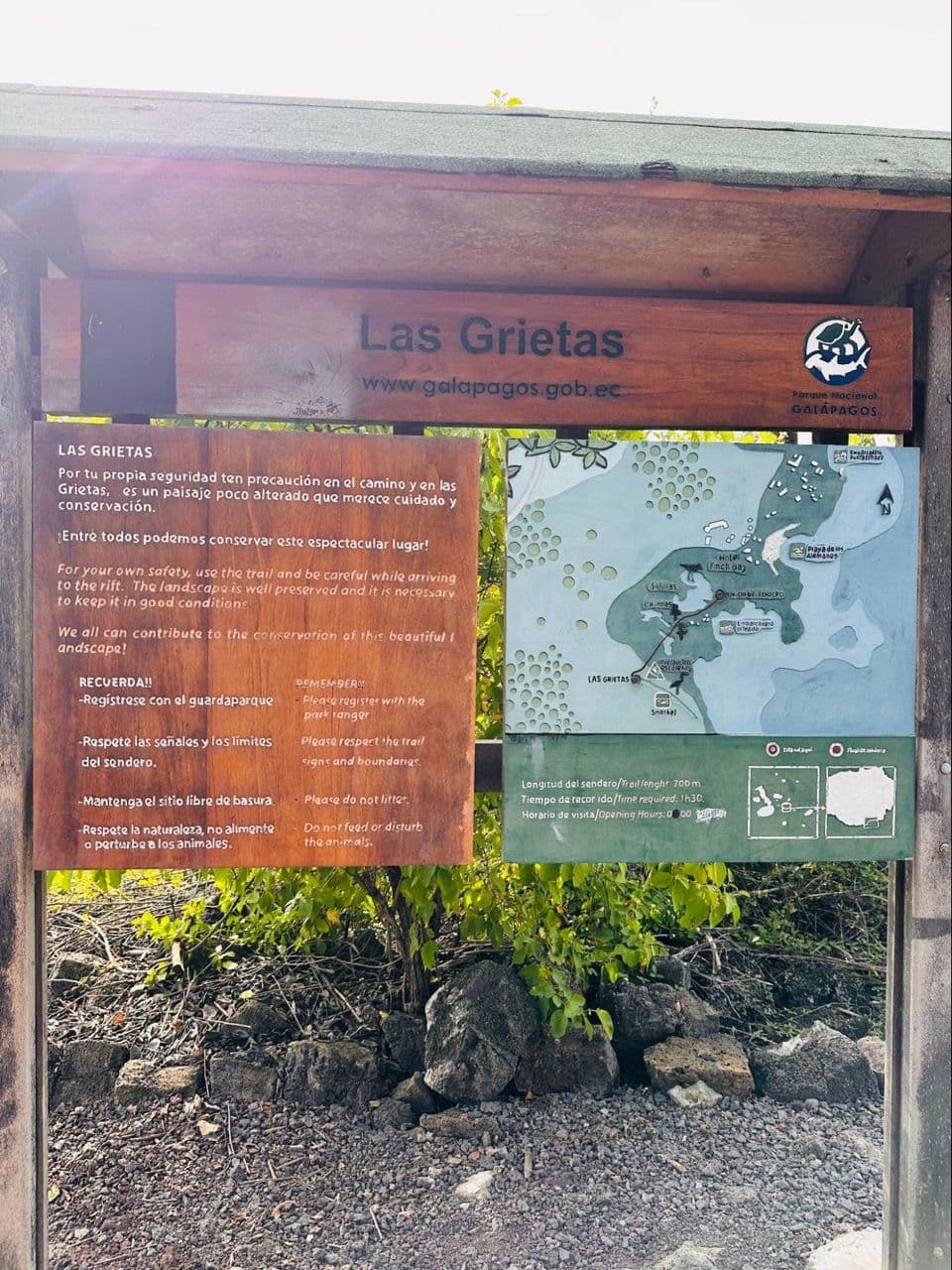
Entrance to Las Grietas, Galápagos National Park
Photo by diana_viajando on Instagram.
How to Get to Las Grietas
Getting to Las Grietas requires a water taxi followed by a hike. From Puerto Ayora's municipal dock, take a water taxi to Punta Estrada for $1 USD per person (~5 min). From there, walk 20–25 minutes along a 1.6-mile (2.5 km) trail that passes Playa de los Alemanes and pink salt ponds before reaching the entrance booth, where a guide is assigned to you. There is no other way to get there, as the area is not accessible by road from Puerto Ayora.
In other words, you wake up early in Puerto Ayora, head down to the dock with coffee still in hand, and board a wooden water taxi that crosses Bahía Academia for one dollar. Five minutes later, you disembark at Punta Estrada, pass Playa de los Alemanes and pink-tinted salt ponds where the first settlers extracted salt, and suddenly the trail opens onto a 33-foot-deep (10 m) lava canyon filled with emerald water. That is Las Grietas, one of those Galápagos places unlike anywhere else.
If you are arriving from another island or Baltra Airport, first read our complete guide to getting to Santa Cruz to plan your transfer to Puerto Ayora.
Water Taxi from Puerto Ayora
Board at Puerto Ayora's municipal dock. The taxi boats cross the bay and drop you off opposite the Finch Bay hotel in Punta Estrada. Water taxis do not require reservations and leave as soon as they fill up with 8 to 12 passengers. You can buy a round trip or pay for the return at the same dock. The fare is $1 USD per person each way. Service runs continuously throughout the day, approximately from 6:00 a.m. to 6:00 p.m.
Trail from Angermeyer Dock
The 1.6-mile (2.5 km) walking trail begins at the dock and takes 20–25 minutes. There is no transportation. The trail passes Playa de los Alemanes and salt ponds, and its final sections cross uneven volcanic rock before reaching a wooden staircase that descends to the water.
These pink salt ponds are a former salt-extraction site used by the early settlers. Their color comes from halophilic microorganisms (Halobacterium spp.) that thrive in hypersaline water, and flamingos sometimes appear to feed there.
The final 656 feet (200 m) pass through a forest of Opuntia cacti (Opuntia echios var. echios, endemic to Santa Cruz) growing on ʻaʻā lava, the sharpest in the archipelago. Closed-toe shoes are therefore required, as sandals are not suitable. A steep, recently renovated wooden staircase descends to the water, limiting accessibility for people with reduced mobility. The trail is free, moderately difficult, and closed-toe shoes are mandatory.
Total Time and Cost Comparison
| Segment | Cost | Time |
|---|---|---|
| Puerto Ayora water taxi | $1 USD/person | 5–8 min |
| Walk to the Las Grietas entrance booth | Free | 20–25 min |
| Guided visit to the three pools | $10 USD/person | ~45 min |
| Return (trail + water taxi) | $1 USD/person | 25–30 min |
| ROUND-TRIP TOTAL | $12 USD/person | 2.5–3 hours |
Complete Logistics: Step-by-Step Route from Puerto Ayora
The exact route is: (1) arrive at the Puerto Ayora passenger dock; (2) take a water taxi across Bahía Academia; (3) walk an average of 20–25 minutes along the trail past the Finch Bay hotel, Playa de los Alemanes, and the salt ponds; (4) pay $10 USD at the GNP booth, where a guide will be assigned to you. Total round-trip time: 2.5–3 hours.
Here is the step-by-step route, so you can commit it to memory:
- Passenger dock (Puerto Ayora). Water taxi boarding point. Arrive before 8:30 a.m. if you want to join the first group and avoid the midday sun.
- Water taxi to Punta Estrada (~5–8 min). This shared boat leaves as soon as it fills up with 8–12 passengers. The fare is $1 USD per person each way ($2 USD round trip).
- Disembark opposite the Finch Bay hotel. The walking trail begins here. There is no road transportation.
- Walk past Finch Bay → Playa de los Alemanes → salt ponds, ~20–25 min over 1.6 miles (2.5 km). The trail is marked, and the final 656 feet (200 m) cross lava. Closed-toe shoes are recommended.
- GNP entrance booth. Pay $10 USD per person in cash, receive your naturalist guide assignment, and attend the safety briefing. GNP hours are 7:00 a.m.–6:00 p.m., and the last recommended entry is before 3:00 p.m.
- Guided visit to the three pools. The visit averages 45 minutes, followed by a return along the same route.
You do not have to swim to enter, but the first pool is 33 feet (10 m) deep right from the edge, so you need to know how to swim to enjoy it. If you cannot swim, you can walk along the edge and observe, but the experience is considerably more limited.
| Service | 2026 Rate | Hours | Note |
|---|---|---|---|
| Water taxi | $1 USD per person, each way | 6:00 a.m.–6:00 p.m. | No reservation; leaves when full |
| Las Grietas admission (GNP, with guide) | $10 USD/person | 7:00 a.m.–6:00 p.m. | Cash |
| Finch Bay → entrance booth trail | Free | N/A | Closed-toe shoes required |
Visiting Las Grietas on the Bay Tour
One of the best ways to visit Las Grietas is on the Bay Tour, which is included in our Quito Tour Bus Galápagos Tours. The Bay Tour combines several attractions in the area and includes a guide throughout the experience as well as snorkeling gear.
Choosing the Bay Tour lets you make the most of your time on Santa Cruz and visit attractions near Las Grietas. We also take you to Canal del Amor, Playa de los Perros, Canal de los Tiburones, and Playa de los Alemanes. This makes it easy to include the destination in a 4-, 5-, or 7-day Galápagos Islands itinerary.
Choose the Quito Tour Bus Bay Tour and discover every corner of Santa Cruz with the confidence of traveling alongside experts trusted by thousands of travelers.
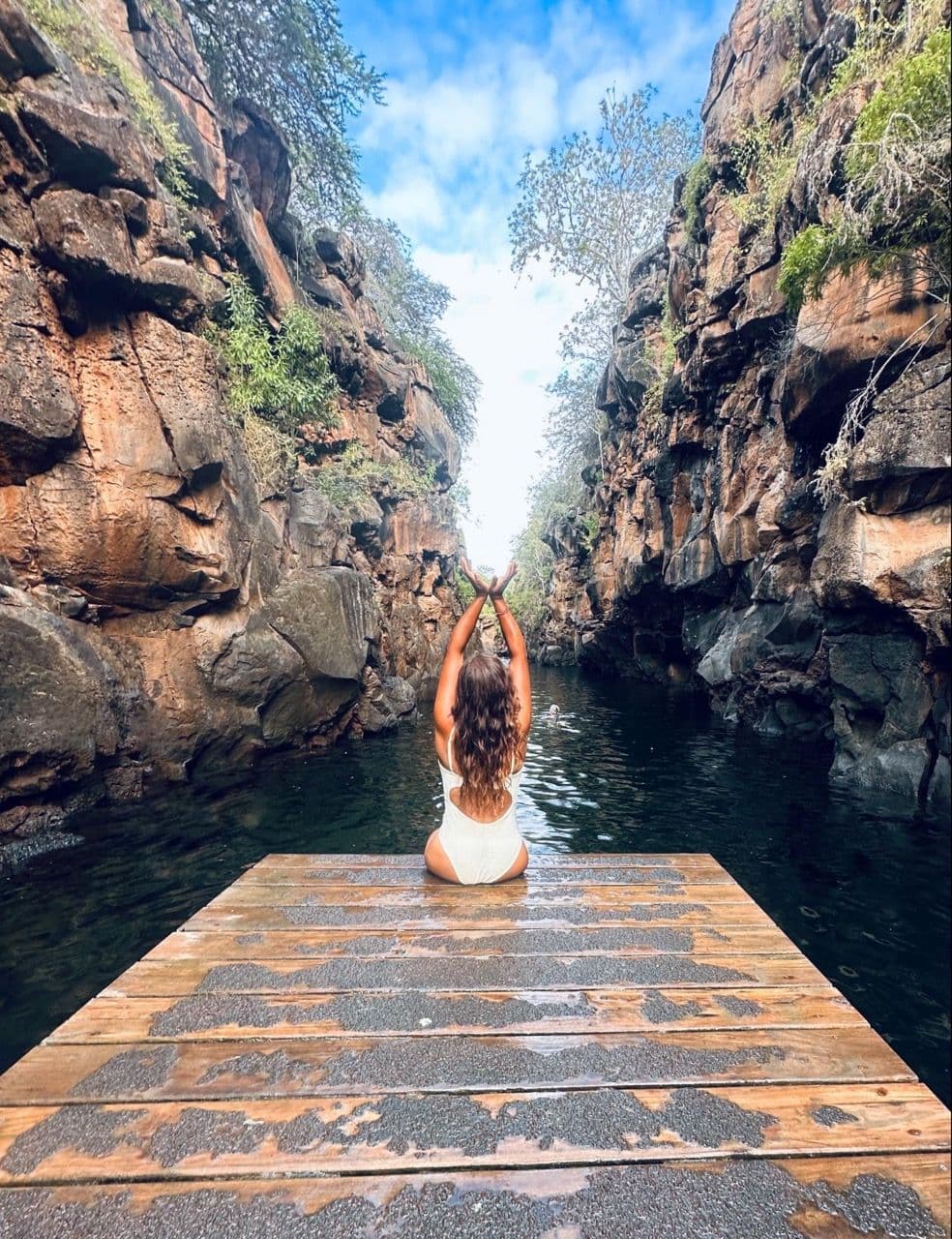
First pool at Las Grietas.
Photo by diana_viajando on Instagram.
What Will You See at Las Grietas?
Las Grietas is not one pool but three connected pools. The first is the largest and deepest, at about 33 feet (10 m) deep, where visitors can swim and float. The second, reached by climbing over a short section of rock, is more secluded. The third lies at the end of the canyon, is almost always empty, and is reserved for experienced swimmers. The access trail includes Playa de los Alemanes, the pink salt ponds, and an Opuntia cactus forest.
| Pool | Depth | Access | Salinity / Water | Wildlife | Best For |
|---|---|---|---|---|---|
| 1st (main) | ~33 ft (10 m), no shore | Wooden staircase | More brackish | Mullets; basalt walls | Swimmers; where the group swims |
| 2nd (middle) | Medium | Climb 16–26 ft (5–8 m) over ʻaʻā rock | Brackish mixture | Parrotfish, mullets | Confident swimmers with proper shoes |
| 3rd (final) | Variable | Rock climb + swimming between sections | Fresher (aquifer input) | Best fish area; almost empty | Experienced swimmers |
The level of each pool varies with the tide (see the geology section above). The guide decides how far the group may proceed based on conditions and visitors' abilities.
The First Pool
This is the main, largest, and deepest pool, at about 33 feet (10 m) deep. It is also where the wooden staircase is located and where the guide gives the safety briefing. With no currents, it is suitable for swimming and floating. Visitors enter by the wooden staircase and can swim, float, and enjoy light snorkeling.
Dip your head a few inches into the water and you can feel the brackish mixture: warm freshwater layers above, cold saltwater layers below, and an almost gelatinous sensation as you move. The rock wall reveals layers of basalt and gas vesicles, remnants of the eruption that formed the fissure thousands of years ago.
The Second and Third Pools
The second pool is reached by climbing between rocks, so closed-toe shoes are essential. These pools are less visited and more secluded, and the guide decides whether the group may enter based on the water level.
Reaching the second pool requires climbing 16–26 feet (5–8 m) over sharp volcanic rock. It is not difficult, but it comes as a shock to anyone wearing sandals. The third pool offers the best views of large parrotfish (family Scaridae) and Galápagos mullets (mojarras of the genus Mugil) trapped by the tide. The fish never leave the pools and live their entire life cycle there. Access requires a rock climb, closed-toe shoes are mandatory, and this is the best area for seeing fish.
Trail, Salt Ponds, and Playa de los Alemanes
The pink salt ponds along the way were used by the first German settlers to extract salt beginning in 1930 and now provide occasional habitat for flamingos (Phoenicopterus ruber). Playa de los Alemanes is a small white-sand cove five minutes from Angermeyer Dock, ideal for a break on your way back (free admission, no guide required).
Want to plan a full day combining Las Grietas with Playa de los Alemanes, Canal del Amor, and the Charles Darwin Research Station? Explore our guide to things to do on Santa Cruz.
What Animals Will You See?
Because of its brackish water, Las Grietas has less marine life than Tortuga Bay or Canal del Amor. You will see parrotfish (Scaridae), Galápagos mullets (Mugil spp.), and occasionally eels hidden in rock crevices. Along the trail, look for lava lizards (Microlophus albemarlensis), Darwin's finches (Geospiza spp.) among the Opuntia cacti, and occasional flamingos (Phoenicopterus ruber) in the salt ponds.
The parrotfish living in Las Grietas are notably large. Some guides say they are among the largest documented in the archipelago's natural pools, possibly because the absence of sharks means fewer predators. The Santa Cruz lava lizard (Microlophus albemarlensis) is endemic to the archipelago. You will see it crossing the trail, and the larger males display red throats during breeding season.
| Species | Scientific Name | Where to See It | Likelihood |
|---|---|---|---|
| Parrotfish | Family Scaridae | Pools 2 and 3 (snorkeling) | High |
| Galápagos mullet | Mugil spp. | All three pools | High |
| Lava lizard | Microlophus albemarlensis | Trail, Opuntia cacti | Very high |
| Darwin's finch | Geospiza spp. | Opuntia cacti along trail | High |
| Sally Lightfoot crab | Grapsus grapsus | Shore at Playa de los Alemanes | High |
| Flamingo | Phoenicopterus ruber | Salt ponds along trail | Low to medium |
| Eel | Gymnothorax spp. | Rock crevices in the pools | Low |
When to Visit Las Grietas and What to Bring
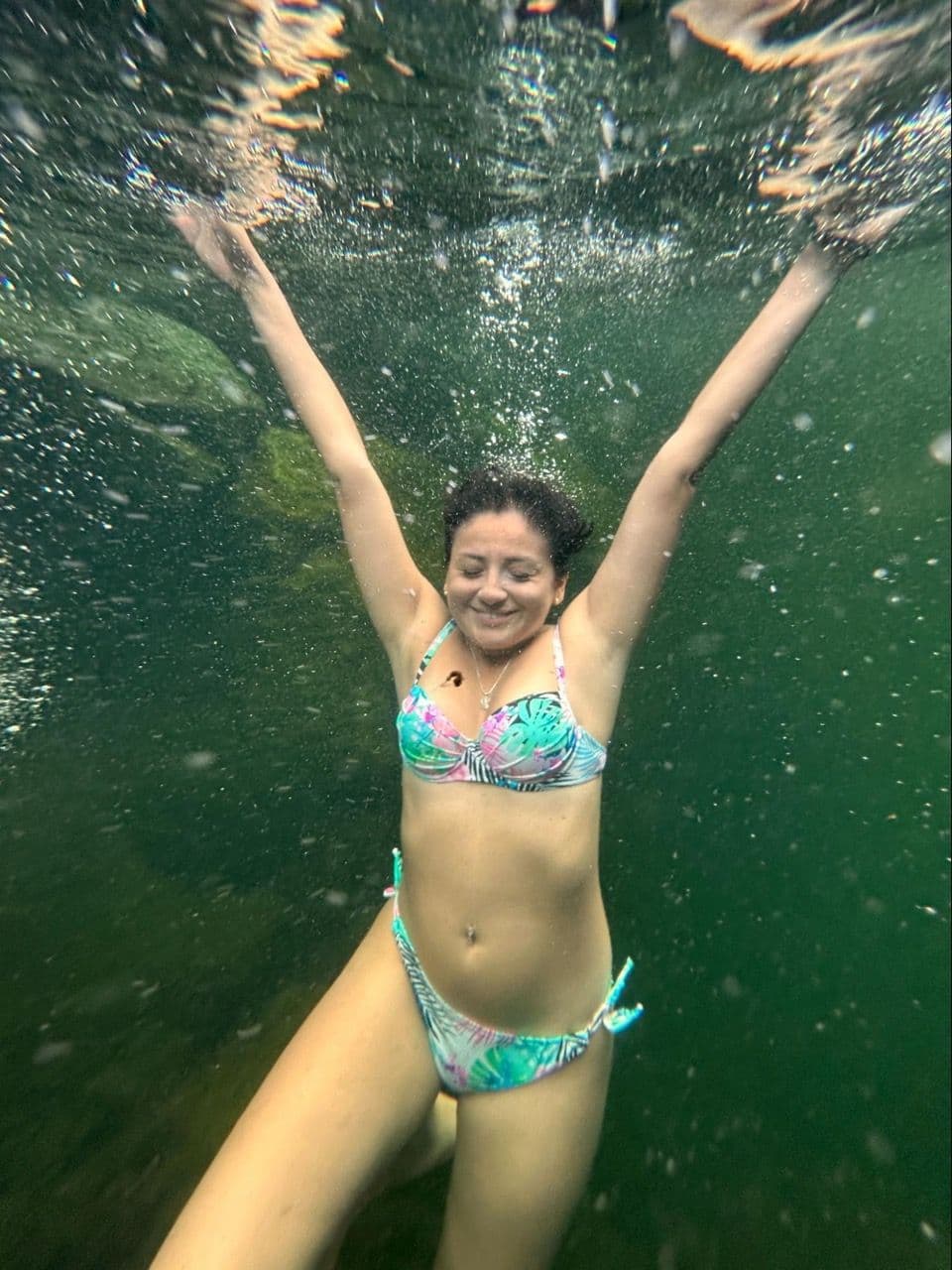
First pool at Las Grietas.
Photo by diana_viajando on Instagram.
The best time to visit is before 9:00 a.m., when the walk is cooler, you can join the first group of the day, waits are shorter, and the light is better for photos. Avoid 11:00 a.m.–2:00 p.m. because of the intense sun and almost total lack of shade along the trail. Bring closed-toe shoes, as volcanic rock can cut; wear a swimsuit under your clothes; and pack a quick-dry towel, reef-safe sunscreen, at least 34 fl oz (1 L) of water, and cash for admission ($10 USD) and the water taxi ($2 USD round trip).
Two things are worth knowing before you leave. The GNP prohibits food inside the protected area, and staff at the entrance booth may inspect backpacks to prevent the introduction of seeds or invasive insects. In addition, the trail has no shade between 10:00 a.m. and 3:00 p.m., so a wide-brimmed hat or cap is practically mandatory even though there is no written rule. No water or food is sold along the trail or at the booth.
Here is a summary of what to bring to Las Grietas:
| Item | Essential | Why |
|---|---|---|
| Closed-toe shoes (no sandals) | Yes | Sharp lava along the final 656 ft (200 m) |
| $12+ USD in cash | Yes | $10 USD admission + $2 USD water taxi; card readers are unreliable |
| Swimsuit already on | Yes | No changing rooms at the booth |
| Water, minimum 34 fl oz (1 L) | Yes | No water or food sold along the trail or at the booth |
| Cap / wide-brimmed hat | Yes | No shade along trail, 10:00 a.m.–3:00 p.m. |
| Reef-safe sunscreen | Yes | Required in the protected area |
| Quick-dry towel | Recommended | Comfort after swimming |
| Personal snorkel / mask | Optional | No rentals on-site |
| Food | Prohibited | The GNP prohibits food inside the protected area |
Las Grietas with Children, Older Adults, and People with Reduced Mobility
Las Grietas is manageable for children who are confident swimmers, with a recommended minimum age of 8–10. Entry to the water is by a steep wooden staircase, and the first pool is 33 feet (10 m) deep with no shore. The site is unsuitable for strollers or wheelchairs because the trail includes uneven stretches of lava and moving between pools requires climbing. Older adults in good physical condition can visit, and the guide will adjust the pace.
Two safety points are essential. The first pool has no shallow area, and visitors enter directly into water 33 feet (10 m) deep, so knowing how to swim is required. Jumping from the rocks into the water is prohibited under GNP regulations for both safety and wall conservation. The recommended minimum age is 8–10 for children who know how to swim. The site is unsuitable for strollers and wheelchairs, and jumping is prohibited.
Frequently Asked Questions
How much does admission to Las Grietas cost?
$10 USD per person, with the same rate for Ecuadorians and international visitors. The fee includes the mandatory Galápagos National Park naturalist guide and a 45-minute tour of the three pools. Pay in cash at the entrance booth. If you still see claims that admission is free, that information dates from before 2021.
How much does the water taxi cost?
$1 USD per person each way ($2 USD round trip). It departs from Puerto Ayora's municipal dock and drops you off at Punta Estrada. Departures run continuously throughout the day, and no reservation is needed.
Where is Las Grietas?
It is in the Punta Estrada neighborhood, west of Bahía Academia on Santa Cruz Island. To get there, take a $1 USD water taxi from Puerto Ayora, then walk 20–25 minutes along a marked 1.6-mile (2.5 km) trail.
Do I need a guide to visit Las Grietas?
Yes, a guide has been mandatory since 2021. You cannot enter the canyon without an authorized Galápagos National Park naturalist guide. The guide is included in the $10 USD admission fee, so you do not need to hire anyone separately.
Do I need a reservation?
No advance reservation is required, as admission is first come, first served. However, groups are limited to 20 people, so arriving before 9:00 a.m. helps you avoid a one- or two-hour wait.
What are the hours for Las Grietas?
The site is open daily from 7:00 a.m. to 6:00 p.m. Guided visits are organized approximately between 7:00 a.m. and 5:00 p.m., with groups departing every two hours. Entry is not permitted after 3:00 p.m., as there would not be enough time to leave before closing.
How much time do I need to visit Las Grietas?
Allow 2.5 to 3 hours from the time you leave the municipal dock: a 5-minute taxi ride + a 20–25-minute walk + 45–60 minutes at the pools + a 25–30-minute return. If you stop at Playa de los Alemanes on the way back, add another 30–45 minutes.
What is the best time to visit Las Grietas?
Between 7:00 and 9:00 a.m. The walk is cooler, you can join the day's first guided group, waits are shorter, and the light is better for photos. Avoid 11:00 a.m.–2:00 p.m. because of the intense sun and almost total lack of shade along the trail.
Can you swim at Las Grietas?
Yes, swimming is the main activity. The first pool is about 33 feet (10 m) deep and has no currents, so you can float, snorkel gently, and observe the lava walls. Jumping from the rocks into the water is prohibited for safety and site conservation.
Is the water fresh or salty?
It is brackish, a unique mixture. Fresh water travels from the Santa Cruz highlands through underground lava tubes and enters at one end, while salt water enters from Bahía Academia at the other. The mixture creates the emerald color and keeps out sharks and large marine animals.
Why is it called "Las Grietas"?
Because that is literally what it is: fissures, or "grietas," opened in the volcanic rock by the geological activity that formed Santa Cruz. The fissure is 328 feet (100 m) long, 23 feet (7 m) wide, and 33 feet (10 m) deep, and it contains three separate pools, not one.
Is it suitable for young children or wheelchair users?
No. The trail has sections of sharp lava, the descent to the water follows a steep wooden staircase, and the first pool is 33 feet (10 m) deep from the edge. It is recommended for children who know how to swim, with a minimum age of 8–10. It is not accessible with a stroller or wheelchair.
Is Las Grietas worth visiting in 2026?
Yes, if you enjoy swimming in unique natural settings. It is the only brackish-water pool enclosed by lava in the entire Galápagos. If marine wildlife such as sharks, sea lions, and reef fish is your priority, combine it with Canal del Amor or Tortuga Bay and its Playa Mansa.
Discover Las Grietas with Quito Tour Bus
Discover one of the islands' most amazing natural wonders: Las Grietas. These three brackish-water pools enclosed within a 33-foot-deep (10 m) volcanic fissure are just a water taxi ride and a walk from Puerto Ayora. Formed by ancient volcanic eruptions, these spectacular natural pools offer crystal-clear water fed by seawater seepage and rain, creating the perfect setting for swimming and relaxing among impressive lava cliffs.
This unique spot combines beauty, adventure, and nature at its purest. Whether you enjoy snorkeling, geology, or simply unforgettable scenery, Las Grietas belongs on your itinerary. Immersing yourself in its waters is an experience that connects you with the extraordinary power and beauty of the islands' volcanic origins.
The Punta Estrada peninsula is also home to Playa de los Alemanes, five minutes from the dock, as well as Canal del Amor and Canal de los Tiburones, so it is worth planning a full day in the area. If you want to combine it with the bay area, visit the Charles Darwin Research Station. Without exaggeration, Las Grietas is one of the most unusual aquatic experiences in the archipelago.
Las Grietas is one of those places that makes a trip to the Galápagos unforgettable. Remember that the Quito Tour Bus Bay Tour lets you discover not only this incredible site, but also other iconic Santa Cruz attractions in a single comfortable, well-organized experience. If you want to make the most of your time on the islands and enjoy a complete adventure, our Galápagos Tours are the best way to make your dream trip a reality.
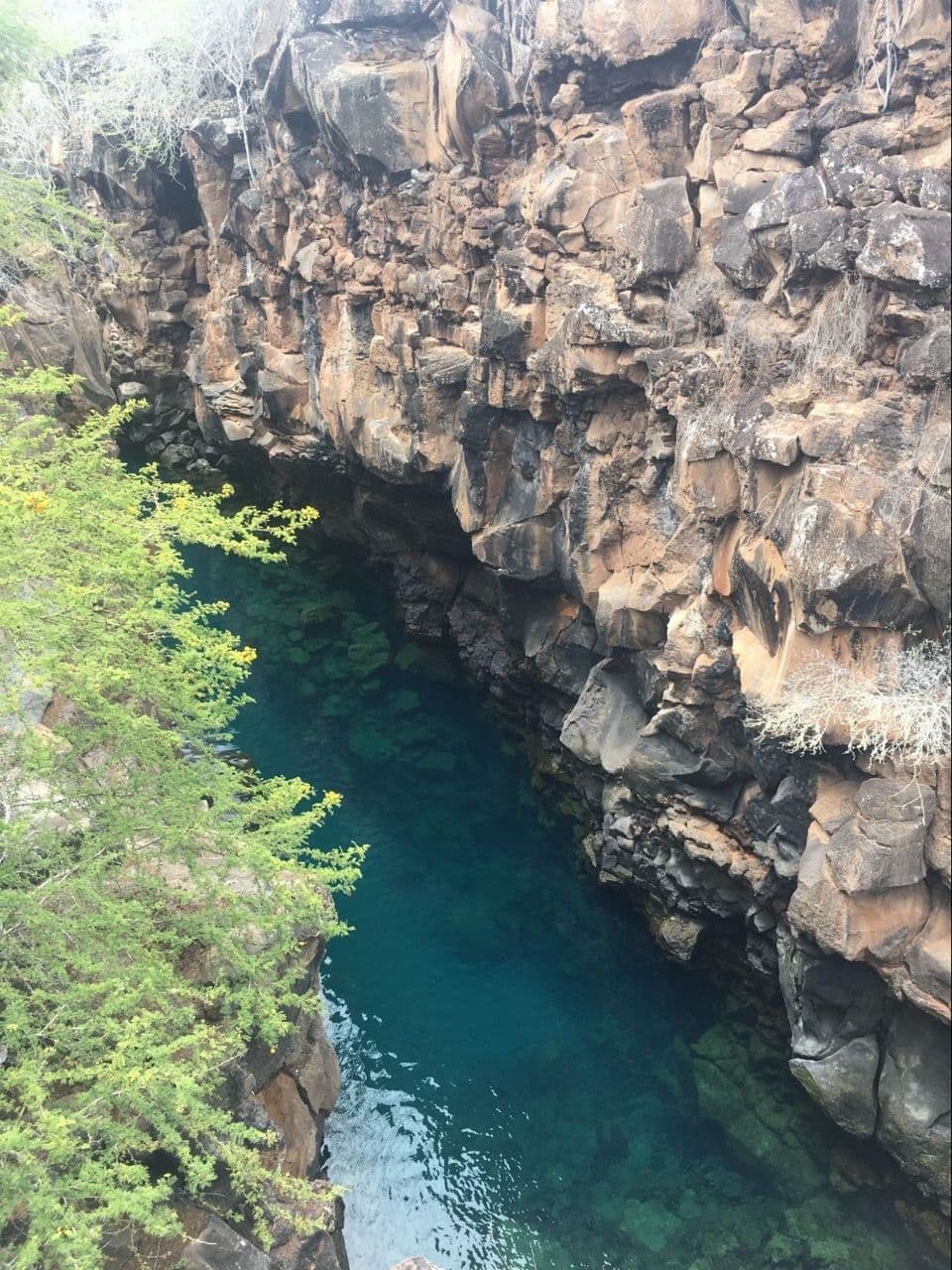
First pool at Las Grietas.
Photo by María Gabriela Mancheno.
Book your Galápagos tour with Quito Tour Bus. With expert guides and flawless organization, all you need to do is enjoy the experience. Explore some of the most spectacular landscapes in the Galápagos, enjoy unforgettable encounters with local wildlife, and create memories that will stay with you forever.
Choose your adventure from our Galápagos Tours and discover why this is one of the world's most fascinating natural destinations.